Showing posts with label Asian Intelligentsia. Show all posts

Wednesday, February 4, 2015

This Town Ain't Big Enough.

The Blackface Of Asian-American Activism

My last three posts (here, here, and here) explored the prevailing zeitgeist amongst Asian-Americans of the activist bent that posits the belief that the Asian racial experience should be reduced to a sub-category of an anti-blackness narrative that permits an Asian voice only insofar as it does not focus on Asians at all, but rather marginalizes the Asian experience and renders it invisible. In particular I pointed out how our insistence on unreasonably framing even the creation of the model minority stereotype as an attack on blacks as opposed to an attempt to allay fears of Asian mass-immigration, has effectively obstructed Asian-Americans access to a vast and autonomous historical experience.

In short, I criticize what I perceive to be an intellectually lazy and vacuous shirking of the responsibility to legitimize an autonomous Asian-American experiential narrative - that includes race - and instead take a position behind African-Americans from which Asians can safely throw rocks at whitey without having to independently address the derogatory racialization of Asians that has been the historical basis for white supremacy since its inception in Classical Greece. I was going to leave it alone but the internet would not let me!

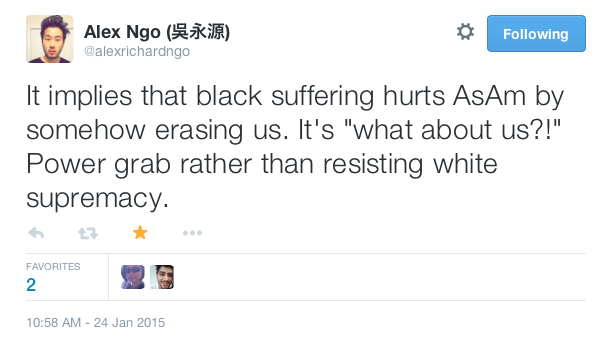
I came across a Tumblr blog that linked a couple of twitter posts by a guy name Alex Ngo (who is a journalist, I believe) that illustrates in one-hundred-and-forty words or less just how damaging intellectual laziness regarding the Asian-american narrative can be.

Here are the tweets....
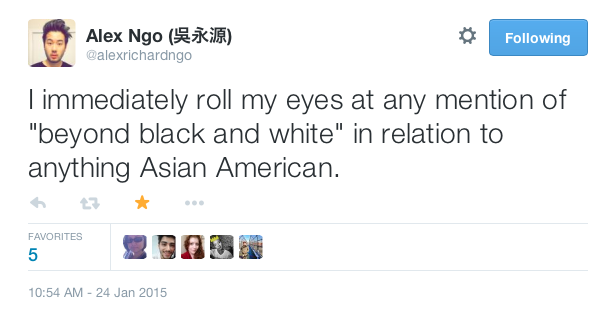


The interesting thing about Twitter is that it forces users to distill their thoughts down to a few key words and concepts that often hints at a more sophisticated underlying social, or political zeitgeist. Such intellectually supported tweets can elicit immense response capable of galvanizing the public to action. Tweets deriving from a far weaker intellectual foundation, on the other hand, elicit little more than an eye-roll. Thus, if the underlying zeitgeist shows a paucity of intellectual depth, then this will be reflected in tweets on the subject. The above tweets are examples of the latter.

If it is incorrect to speak '"beyond the black/white' in relation to anything Asian-Americans", then the very concept of Asian and Asian-American has no reason to exist. By extension, any and all endeavours of such an entity have no purpose or meaning. Asian-American movies, literature, art, as well as contributions to science, politics, and philosophy are all rendered non-existent because much of this endeavour exists and takes place well outside of the artificial and hopelessly simplistic limitations imposed by the black/white framework.

This is particularly significant in light of the notion of diversity and the exclusion of Asian-Americans from considerations thereof. One of the arguments of diversity advocates is that it is necessary as a means to prepare today's generations for the increasingly globalized economy of the future where they will be required to compete in a diverse environment. How strange it is that in a world where the combined population of South, East and Southeast Asia approaches four billion (over half of the world's population) the diversity theory that claims to prepare Americans for what amounts to a world chock-full of Asians, would actually exclude this key demographic from the diversity dialogue.

Asian-American advocates who insist on maintaining the narrow black/white framework as a means to do who knows what for blacks and Asians, merely do a disservice to their own diversity goals. What exactly are such convoluted notions supposed to teach us about the place of Asians in the world if we insist on invisibility as a strategy and propose that exclusion from diversity considerations are acceptable? Are we to send our diversity-empowered future generations out into a global marketplace where the majority of people have Asiatic faces with the idea that their stories and experiences are insignificant or secondary? For those who claim to be fighting white-supremacy that is a remarkably western-centric point of view.

Clearly, if diversity advocates are genuinely hoping to prepare Americans for the global marketplace, we have to increase the visibility of, and mainstream, the Asian-American experience as an autonomous and unique experience in its own right in order to familiarize the American public with ways to successfully negotiate a world that is full of Asians. But, it is the second tweet above that illustrates the poor reasoning fostered by the simplistic assertion of the primacy of the black/white framework.

Simply put, there is no logical reason to presume that a call for less invisibility for the Asian-American narrative is in any way in conflict with anti-anti-blackness activism. This is merely an arbitrary dichotomy that is false and makes no logical sense. If Asian-Americans cannot fathom a way for an outspoken, autonomous, and visible, Asian-American experiential narrative to co-exist with social justice activism, then that merely speaks of the limitations in their thinking and does not reflect any real conflict of interests. It is worth noting that despite all of the impassioned claims that Asian-American anti-anti-blackness reactivists have made about the need to forego any consideration of an independent Asian-American voice, none have ever bothered to explain why such a dichotomy is mutually destructive. We are simply told to believe that an autonomous Asian-American narrative harms blackness, so shut up and fall in line. At least provide us the courtesy of explaining such assertions, otherwise shut up.

The fact is, that there is already an Asian-American experience that is independent of the black/white framework in spite of the best efforts of Asian-America's racial justice reactivists to ensure that such an experience remains marginalized. If there are some who wish to diminish, banish, or ignore this experience, then let them step aside and permit those who find value in the rich history of Asian-American endeavour to speak for the community.

I see absolutely no conflict or obstacle in seeking to explore the Asian-American experience as an autonomous endeavour and the fight for social justice. That is merely a bizarre notion entirely made up by social justice activists for some reason that I cannot even begin to understand or even consider worth the effort of trying to understand. It is that absurd.

Saturday, March 9, 2013

Seven Things.....

...That Hurt Our Feelings.

I came upon this article at a site called Diversity Inc., via the 8Asians blog, that relates seven things people (non-Asians presumably) should never say to Asian executives - although I think Asians in any field or position of employment would be equally troubled by them. There are a couple things about the article (and 8Asians blogpost) that are of interest, and illustrate how I believe - and have written about in several posts - the way that Asian-Americans engage in race dialogue ultimately misses the point when it comes to commentary on anti-Asian prejudice.

The first point of interest is how "offensiveness", once again, defines and characterizes the way that we talk about our experiences of racism. According to the 8Asians post, the Diversity Inc. article shows why these questions are potentially offensive, and although the article itself makes brief mention of how expression of these stereotypes could reveal underlying discrimination, it doesn't really explore this notion in the ensuing article. As I've written about in several places, our tendency to react and respond to racism by being offended misses the point of how stereotypes can affect us. On a side note, I would conjecture that this type of Asian-American commentary has a feminine character possibly due to the fact that it is Asian female perspective that has come to dominate the Asian-American narrative, and it is the feminine voice that has modeled our commentary on race.

If racism is simply "offensive" to us, then we really have no cause or reason to organize against it because the fundamental solution to being offended about something is to grow a thicker skin. In turn, this means that the cultural and social structures that promote and propagate racist attitudes towards Asians have no real reason to change because the problem is our feelings. Racist attitudes against Asians in the media, culture, and politics, all point to a culture of casual racism that is comfortably low-key, yet often potentially casually life threatening or violent. Continuing to present our experiences of casual racism, or racial insensitivity, as a mere affront to our emotions is inappropriate and to continue to think of and explore anti-Asian racism through this filter offers only intellectual stagnation.

I won't go into each question in detail, but here is a list of the questions (copy pasted directly from the 8Asians post).
  • "You must be the IT person.".  
  • “You aren’t like them” or “You don’t act very Asian.” 
  • “Asian Americans are not risk takers.” 
  • “Where are you from? No, where are you really from?” or “When are you going to go  home?” or “How often do you go home?” 
  • “Oh, you speak English good!” or “Do you speak your language?” 
  • “You’re not a minority because all Asians are rich and successful.” 
  • “You’re not Asian, you’re from India.”
Here's rub; in and of themselves, most of these questions are not even all that offensive - granted that could be my subjective opinion, but I think that if we are really honest with ourselves we would admit that most of these questions have no real profoundly offensive quality - although we would have cause for concern. Yes, when we are asked these questions we can justifiably roll our eyes, and sigh to ourselves that we may be dealing with another individual who may be honestly ignorant, or just plain rude, but to become offended is, in some ways, accepting loss of control over yourself. These questions are, however, problematic because they hint at a profound, casual, and even a dangerously oblivious, discrimination.

In reality, far from merely causing offence, these questions reveal some deep-rooted beliefs that mainstream America takes as axioms which may indicate that Asians are being casually (but profoundly) discriminated against because of socially acceptable stereotypes derived from racist attitudes. In short, if you encounter people in your place of work who make remarks like these - particularly those in supervisory positions - then you probably have good cause to think that the people who believe these stereotypes may also be limiting your opportunities. So, don't become offended - that is just inappropriate, and diminishes the potential severity of the issue.

The second, and more significant, point of interest about the article is its brief allusion to management and leadership qualities. This is what the article says.....
Not only are they (Asians) stereotyped as not leadership material, but their cultural norms are interpreted by U.S. born executives as proving the stereotype.....“In America, the leadership skill is defined by how confrontational, direct and aggressive you are,”
I just don't agree that aggressiveness, or being confrontational, are as significantly valued leadership qualities in the West as this quote would seem to suggest. Unless you are in a martial profession, or sports, or any line of work that specifically requires aggressiveness, then aggression and confrontation, just don't go down too well with co-workers or underlings alike. In fact, if you are in a service profession, then these qualities definitely put you at a disadvantage as a leader if you are in the business of keeping customers happy. Leadership requires far more than testosterone for it to be considered successful and this idea that aggression and confrontation are highly valued is little more than a red-herring. Yet, it seems to me that in an extremely ironic twist, some Asian-Americans seem to have a caricatured, stereotyped, notion of  leadership as it is practiced and conceived of in western cultures.

My experiences in the workplace leave me skeptical about claims that non-Asians ( i.e. white dudes - let's be honest) have some kind of superior aptitude for leadership. Most of the white dudes that I've worked with have actually been poor leaders who attained their position through kissing the right superiors' butts, and shitting on their co-workers at opportune moments. Asians forget that massaging the right peoples' egos gets you noticed more than actually possessing leadership qualities. Of course, once in a leadership position the facade often falls away and any shortcomings are quickly and painfully revealed.

Some might say that this simply shows that white dudes are better at maneuvering themselves into leadership positions - supporting the idea that culturally they are better suited to leadership. The problem here is that having the skills to manipulate yourself into a leadership position doesn't equate to having aptitude for leadership once you are there. And let's be honest; the path to consideration for leadership for a white dude is significantly smoother than for other demographics - neutral or positive presumptions and such.

Unless a white dude has an arm growing out the side of his head, it is safe to assume that he will be more readily accepted without too much questioning - there are few (if any) negative race specific preconceived stereotypes about white males and so it is likely that face value goes further. So the system fosters ease of integration into leadership circles. Asian-Americans also overlook the fact that American culture is as much about bluster as it is about substance. Only seeming to have the talent and drive to achieve fame, wealth, or positions of leadership, is what most of us mistake for good leadership skills when, in fact, the bluster is most often greater than the substance. This is almost like the American version of the "Asian" phenomenon of "face-saving".

This isn't to say that there are no good white leaders - that would be absurd - I'm simply saying that we tend to mythicize leadership qualities instill by American culture to such a degree that we lose all perspective second-guessing our own abilities. The real question is; do Asian cultures produce individuals who lack aptitude, or is America's cultural antagonism towards Asians conditioning Asian-Americans to believe that they have no inherent leadership qualities?

According to the "general consensus" - to which many Asian-Americans themselves adhere - Asian cultures instill compliance and deference to authority. Asians are, thus, followers, and not leaders. Given this axiom, we should expect to find few, or no, examples of rebellions, or uprisings, in Asian histories - compliant people don't revolt because they are, well, compliant. Yet, Asian history is full of rebellions and uprisings against unpopular or unjust rulers and officials. Even more tellingly, further evidence that Asian compliance is a myth can be seen in the often volatile relationship between Asian societies and their governments.

It is often said that Asian compliance manifests as a lack of active engagement in politics. Yet, history and the news - for those who notice - provides ample evidence to the contrary. Asians engage with their government through protest all the time - that is, they are extremely outspoken in challenging authorities in their own societies. Even in China - I say "even" because China actively suppresses dissent on top of being, supposedly, a culture of compliance - I am always reading about some protest somewhere in which average Chinese citizens are risking their lives to express their dissatisfaction with government. All over Asia you might notice that Asians routinely stage protests against their own leaders - even in countries where they might face death for doing so. Does this sound like compliance? No, it actually sounds like a culture of non-compliance. When you start to notice these things it becomes increasingly difficult to not believe that the "Asians are inherently compliant" type explanations are little more than cheap throw-away justifications for discrimination.

I think, therefore, that it is more likely that Asian-Americans do not make it into leadership positions because American culture has conditioned many of them to believe that they are unsuited to it, has conditioned mainstream America to think of Asians predominantly in demeaning ways, and thus, devalues any authority or leadership qualities that some of us may possess. My sense is that mainstream America is so conditioned to think of Asians derogatorily that this perspective overcomes their ability to objectively assess leadership qualities of Asian-Americans. The result is that because of such profound conditioning, both mainstream America and Asian-Americans themselves believe Asians to be less suitable for authority even though evidence to the contrary may be staring them in the face.  What this suggests is that if culture does play a role in shaping leadership qualities then for Asian-Americans it is American culture as much as anything else that provides the impediments to Asian-American leadership potential.

In summary, I would say that Asian-Americans are doing themselves a disservice by seeming to mythicize leadership in such an unrealistic way. The reality is that the entire culture of America is set up to ensure that white males succeed and that the door never closes on them the way it does on others. This is not to dismiss the idea that there may be some cultural conditions affecting smooth integration of Asians, but I believe that we, and mainstream America, are exaggerating the degree to which this may be the case. By doing this we are enabling the justification of discrimination.

I will finish by saying that cultivating a state of mind that responds to racial insensitivity, or discrimination, with offence is, funnily enough, not a quality becoming of a leader. The reason is, that being offended draws a line in the sand but offers no solutions. A leader,on the other hand, will assess the situation at hand, identify the ramifications of it, and find ways to get passed it, go around it, or overcome it. Being offended has no place in the fight against discrimination or in the skill-set of strong-minded leaders. It is also fundamentally a feminine stance that has no meaningful place in the dialogue and that also happens to offer little by way of solution.

Wednesday, February 6, 2013

Self-Censorship.

Because I'm Asian!

It should go without saying that racial stereotyping of Asians in American culture remains a significant issue that promotes negative attitudes and behaviours, and is a prominent factor in maintaining our cultural invisibility and marginalization. One way that negative stereotypes work is by promoting the idea that personality characteristics can be applied to an entire group so that members of that group are no longer viewed as individuals but as people whose character can be largely deduced from their racial grouping. In other words, stereotypical thinking overlooks individual qualities and promotes a simplified and dehumanized conception of a given group. The results of this simplification enables prejudicial behaviour on all levels, ranging from petty racism and harassment to violence or genocide.

For Asians in 21st Century America, this process of de-individuation is especially pertinent because it has become an axiom of modern American thinking that Asians are a fundamentally "group-oriented" - which is the acceptable way of saying that Asians lack individualism. The reason for this is tied up with decades (centuries even) of xenophobic thinking, fears of growing Asian global economic and political clout, and notions of Asian inferiority lingering at the core of western philosophical thought. Asserting that Asians are a "hive" - that is, submissive to and unquestioning of authority, as well as void of personality and creativity - serves to alleviate these fears by factualizing racist stereotypes; yes, Asian economies are strong, but Asians can't think, or Asians can't innovate, or Asians aren't creative, and so on.

The results of this process are starting to slowly reap an increasingly confident harvest of voices that seem to promote a kind of liberal institutional racism affecting Americans of Asian descent. For example, at all levels of education the "Asian Question" is being debated. Under question is the legitimacy of Asian-Americans' academic achievements - the increasingly general consensus being that the Asian lack of creativity and personality nullifies their high test scores, thus, making their high college attendance rates a kind of unfair obstacle to the rightful attendees - Latinos, blacks and whites - whose creativity and personalities are more deserving of college places, even though testing might show that many are not up to scratch academically.

Of course, entertainment provides us with a wealth of examples of how the notion of lack of individual personality qualities in Asians are both reflected and propagated through the medium of popular culture. Representations of Asian people (particularly Asian men) in America's media are heavily restricted to just a few limited types; enemy, arch-villain, side-kick, nerd, loser, yet almost never an individual with human or even humane qualities. The extent of this extreme limitation in imagery is so acute that it could be said to resemble censorship in its scope and practice. Naturally, these commonly accepted truths about Asian people leads to negative behaviours that have become socially acceptable modes of interaction for mainstream America with its Asian minority. Such is the acceptance of stereotypical thinking towards Asians that racial harassment of Asian at all levels of American society is openly and gloatingly reflected (and perpetrated) in film and television.

Yet, for me the worst aspect of this process of de-individuation is that many Asian-Americans themselves seem to adopt this way of thinking. For example, I watched a reality show recently - Hell's Kitchen if you need to know (don't judge!) - in which an Asian-American contestant was talking about a mistake he had made cooking a dish with fish and miso. His comment was that he shouldn't have made the mistake because "he was Asian" and he should know how to cook miso and fish. Yes, I know it was supposed to be light-hearted and cutesy, but this manner of expression actually reinforces de-individuation - in truth, the Asian chef should have known how to cook fish and miso because he is a chef with years of experience, not because he is Asian.

This way of thinking and expressing one's experience seems to be common amongst Asian-Americans. You see it on internet forums, you see it on blogs, you even see it coming from our "intelligentsia". Any number of qualities, characteristics, or experiences are explained (in whole, or part) as being, fundamentally, the result of "being Asian". Expressing our experience in this way is an implicit denial of individuality and, thus, a reinforcement of stereotypes. In a  fairly recent infamous example of this - as I wrote about here - Tiger Mom's brief flirtation with child-bullying infamy was littered with agency and individuality denying caveats - her action were implied to be somehow pre-determined by her culture or Asian-ness, and therefore mitigated by factors outside of her control. Yet, it is the expression of our individuality that we need to be nurturing because that is the predominant way that stereotypes dehumanize minorities.

This may seem like a minor peeve and an ungenerous criticism of a casual or playful way of expression, yet it could be seen to be a measure of the degree to which Asians are racialized in American culture. The first and most significant aspect of this process reflects the one-sided representation, and fundamentally hostile, manner of the cultural marginalization of Asians. Culture provides individuals with a reinforcement of their sense of inclusion and belonging to a society. Thus, culture reinforces (as well as propagates) beliefs that individuals have about themselves, their group, and their society by depicting recognizeable qualities and characteristics of society via archetypal characterizations and heroes with whom viewers can identify and hopefully recognize those qualities and characteristics within themselves.

In America, this avenue of identification doesn't exist for those of East Asian descent - in fact, the very opposite occurs; Asians (particularly Asian men) are explicitly excluded from identifying with America's cultural and social identity either via invisibility or racial-baiting. And perhaps it might be that with this very limited racialized frame of cultural self-reference for Asian-Americans becomes the only means through which they know how to view themselves - thus incorporating the very language and thinking that is the means of their exclusion. And this highlights the second aspect of of this phenomenon; Asian-American culture itself.

If it is true - as I've suggested - that culture promotes a kind of identity-consciousness of a society by presenting ideas, and language which enables individuals to explore, and develope their personal sense of individual identity, then the implication is that Asian-American culture still has a way to go before it can be said to have a similar influence on Asians' self-perceptions that mainstream culture has on the mainstream. Is our burgeoning Asian-America, and the culture it reflects, providing a language of self-description, that we can then recognize in others like us, and find community through the means of the language of individuality?

This obviously a loaded question and one to which I will say that I don't know the answer. But casual observation of Asians interacting with mainstream America suggests that many of us have adopted the language of stereotype and de-individuation, as opposed to the language of personal empowerment, and individual agency. This is a form of self-censorship - one that may even be unconscious most times - and it illustrates the power that demeaning imagery can exert on the mind.

Monday, December 26, 2011

Stupid Ass.

Hollywood Is Race-Blind!

This just in; Hollywood is race blind. The bigWOWO recently posted this revelation, compliments of one Dan Lin - a Harvard Business School graduate turned film producer. According to Lin, quoted in this article.....

“I guess for me I don’t see a lack of Asian American actors. I think more and more Asian American actors are getting out there,” Lin said, adding that Hollywood is race-blind. “It’s all about who tells the best story. They don’t care what ethnicity you are, they just want … the most talented.”
Nice one.

The most surprising thing about this news is that no-one else in America seems to have noticed this remarkable fact. Given that can we know for sure that racism is prevalent in most, if not all, aspects of American society, it is truly amazing that not one activist, social scientist, Liberal, or academic, seems to be aware of the forward-thinking, race-blind Utopian industry that happened to manifest spontaneously in Hollywood.

It would be nice to hear how Hollywood has succeeded in achieving the feat of ending the racially biased thinking that afflicts the rest of American society. No other institution in America can boast that it has eradicated the kind of petty racially inflected thinking that discriminates against minorities in every level of American society. Whether it be in housing, college applications, incarceration rates, poverty rates, minority representation in management positions in industry, the fact is that minorities undergo biased attitudes in almost all aspects of their lives. So, it would be nice if Hollywood would show the rest of American society how to go about the same transformation.

According to Lin, the one exception to this prevalent social ill is Hollywood - which is race blind - yet no-one has noticed this except for Dan Lin.

In other news, reports suggest that the military is also race-blind. Sources close to Hollywood report that the story of Danny Chen's race-blind experience in the army is to be made into a movie. The role of Danny Chen will be played by either Shia Labeouf, or another white actor. Lin may be producing. Stay tuned.

Sunday, December 18, 2011

Someone Get's It!

Stephen Chan Telling It Like It Is.

I came across this fascinating debate on the subject of the China's investments in Africa. As you might notice the side opposed to Chinese investment employs mainly shrill, generalizations that are little more than xenophobic fear-mongering. In this video, some Chinese dude named Stephen Chan exposes, in the most eloquent way, the blatant racist attitudes towards both Africans and Chinese that underlies opposition to Chinese investment.


You should also check out Chan's website - he appears to be something of a Renaissance Man; writer, skilled martial artist, world traveler, philanthropist, intellectual, husband, government advisor, and the list goes on. Here's his website......http://www.stephen-chan.com/index.html. Sounds like a good role-model!

Also, check out what this lady has to say about the realities of Chinese investment in Africa.....

http://www.youtube.com/watch?v=qHEpsXmmD48&feature=BFa&list=SPE7865CD7C141D230&lf=list_related

Monday, October 10, 2011

Stupid Racists?

The Elephant In the Room....

The 8Asians blog recently published a post in which Eugene Lui, the founder of a political group called the Asian Conservatives, gave an interview in which he talks about how Asian-Americans might fit into the landscape of American politics via the ideology of conservatism. Also discussed was how he, as a conservative, conceives of the issue anti-Asian racism in the media, as well the reasons for the apparent dearth of Asian-American conservative bloggers. Here is what he has to say about perceived anti-Asian racism in the media......

Well, I think “racist” has been used so much in the mainstream media these days that the word has lost its meaning........The Civil Rights Movement — that was about racism. Somebody calling me names and making fun of my slanted eyes — that’s just an immature moron stating the obvious..............................Okay, I’m going to say it: Dear libs, stop being so sensitive to every. little. thing. If a popular sitcom doesn’t have an Asian actor, that doesn’t mean the viewers don’t know that Asians exist. If an Asian actor portrays a nerdy student in a Hollywood movie, that doesn’t mean everybody thinks we’re nerds (do you think blacks — ahem, African Americans — are nerds after falling in love with the Steve Urkel character?). It’d be an issue if Asian American citizens were denied voting rights. It’d be an issue if Asian Americans were being persecuted as a follower of Taoism, Buddhism, Hinduism, Falun Gong, or some other religion. It’d be an issue an Asian Americans were being taxed differently than other ethnic groups. It’d be an issue if Asian American parents were prohibited from making babies. .......Remember: Life, Liberty, pursuit of Happiness.
I was quite surprised by this response for a number of reasons. The idea that media portrayals can challenge traditional family values is a prominent notion in conservative thinking. It is a conservative view that media depictions of glamourized casual sex, casual drug use, and homosexuality, can and do have negative affects on the thinking, moral decision making, as well as the behaviour, of America's youth in particular and society in general. Even foul language and explicit language in songs might be viewed as a potential threat to the morality of the traditional family.

The gist of such thinking is that culture influences (or even directs) public opinion and behaviour, and normalizes activities that run counter to traditional values of moral thinking. Thus, such unwholesome cultural endeavour is seen to play a major role in how individuals within a society views themselves, what they consider appropriate morally and behaviourally, and ultimately shifts the compass away from traditional concepts of moral and upstanding behaviour. Additionally, culture is also a reflection of what is actually socially acceptable - popular cultural depictions merely mirror the realities of social interactions. So whilst popular culture can direct opinion and behaviour, it also reflects the reality of how people within the society may actually be behaving and thinking, as well as identifies the ways in which individuals view themselves in relation to others within the society.

If the conservatives are correct that permissiveness in the discourse of popular culture has the capacity to alter individuals' social behaviour, then it must logically follow that negative depictions of Asian people have the capacity to promote and normalize negative behaviour towards Asians. Many people seem to believe that pornography and some depictions of casual sex in film and television can lead people to have sexist attitudes towards women which might ultimately contribute to an environment conducive to harassment, rape, or even violence. It should follow that any media representation of any given group that promotes a demeaning one-sided view can lead to negative social attitudes and behaviours. In order to deny that demeaning and negative stereotyping of Asians contributes to negative behaviours towards that group one must necessarily question or deny that media pornography or casual sex, violence, foul-language, and casual depictions of drug use, can negatively impact moral decision making, or normalize such activities. This runs counter to the claims of conservative moralism.

It is impossible to deny that most representations of Asian people in the American media are one-sided and tend to be derogatory, xenophobically histrionic, and generally dissmissive of any value in Asian people or contemptuous of any contribution of their cultures to the richness of the human experience. Whether it be movie characters, politicians looking for cheap votes, or celebrities trying to be controversial (paradoxically, without stepping on any important toes!), the general tone is the same - Asians are demeaned or dehumanized, ridiculed or mocked, villified or dismissed. Given this general conservative belief that the media and influential personalities can impact people's ability to make responsible moral decisions, and thus affect behaviour, it seems naive (or maybe dishonest in some cases) to offhandedly dismiss derogatory images of Asians.

Of course, one could read this post and think to oneself; "So what?!" Aren't Asian-Americans outperforming everyone in universities, the workplace, income levels and so on and so forth? Isn't it trite to complain about the media when Asians are so successful in America? Surely, our success is an indication that the negative attitudes and racism propagated by American culture do not affect our ability to prosper? Whilst I cannot disagree that some segments of the Asian-American community do succeed, such an attitude reflects a lack of nuanced thinking common amongst Asian-Americans that, I believe, is almost as big a detriment to our prosperity as are racist attitudes.

History shows that when a society promotes negative attitudes and stereotypes about an unpopular group, then the result is usually unpleasant - even in situations where the target group has acheived a degree of integration. The Jews of Nazi germany provide the best example of this. In the years before the Nazis came to power, Germans of Jewish descent were amongst the most prosperous and highly educated people within German society. Yet, the Nazis were able to exploit negative attitudes, behaviours, and stereotypes that had persisted about the Jews to bring about the holocaust. Smilarly, the South Indians of Uganda were a prosperous minority, but persistent hostility towards them led to their eventual expulsion.

Then there are the Americans of Japanese descent who, prior to Pearl Harbour, had become a somewhat integral part of west coast life. Their slow but definite progress towards prosperity was rudely interrupted by an internment process caused by paranoid fear, and enabled by the persistence of racial hostility and resentments. The point should be clear. Any minority against whom negative attitudes and resentments are harboured, are likely to fall victim to some kind of backlash. Unfortunately for us Asian-Americans, we live in a society whose culture actively, cynically, and deliberately, promotes harassment of Asian people.

In short, it's difficult to see how one can hold to the belief that the media and it's personalities can influence the moral compass and behaviour of American society, whilst downplaying the idea that media mockery, and misrepresentation of Asians can lead to negative outcomes for Asian people. For this reason, conservatives of all people should understand this better than anyone else - Asian conservatives even more so. It is simply avoidance to characterize as "stupid' or "immature", the casual and routine racism enabled by the cultural normalization of anti-Asian harassment. In fact, the culture of harassment of Asians is so integral to the American psyche, that it is even normal for America's children to routinely express hostile attitudes towards Asians. It may be true that many Asian-Americans have achieved prosperity, but given the fact that attitudes of resentment and distrust are spitefully promoted in American culture, any prosperity seems built on a weak foundation.

Sunday, June 5, 2011

Asian-American Culture......

....How White Is It?

Over the past year or so, Asian-Americans have been the recipients of some atypical mainstream attention due to a couple of articles written by members of the Asian minority that reported on the negative aspects of "Asian" family culture and how it has the potential to affect integration and acceptance of Asians into mainstream life. Of course I'm referring to the Tiger Mom and Tiger Cub articles which were both published in mainstream publications.

As readers will probably already know, both articles were met with a variety of responses - some expressed agreement, many more expressed resounding disagreement. Upon reading many of the negative reactions to these articles, it became apparent to me that many people were not only reacting to the fact that many negative things were said and implied about Asian people, but also to the fact that these things were said in mainstream publications to a mainstream (and let's be honest, we're talking about publications whose audience is likely to the majority white) that already has cultural structures in place whose apparent purpose is to propagate negative attitudes about us. Why waste what few opportunities that we have to present our point of view by simply repeating to the mainstream many of the negative things that they are already saying about us?

One needn't limit oneself to these two articles to notice that much of what Asian-Americans publish or write about themselves and their cultures in white mainstream platforms follows this pattern to some degree or another. Typically, this type of expression of Asian-American culture, carries with it much drama and hyper-criticism of self and one's culture. Unfortunately, it's never really made clear why we should believe that white mainstream actually gives a crap about Asian-American angst, yet somehow this idea of appealing to, or creating for, the (white) mainstream has apparently become a prominent goal of Asian-American cultural practice. Sadly, implicit in this pattern is the understanding that mainstream racisms and prejudices must be diluted or downplayed, leaving one to wonder whether this drive to manipulate Asian-American cultural expression into a mould that is palatable for the white majority relinquishes its autonomy and simply renders it a sub-category of mainstream white culture.

Of course, it can be said that since the mainstream offers the widest possible opportunity for acclaim that it would be natural to want to appeal to this demographic. Yet, this doesn't really provide us with a good reason for the tone and theme of much mainstream-in-mind Asian-American culture to be so self-denigrating or negative - in fact, it almost seems as though this cultural contrition is a requirement for acceptance by the mainstream.

This reverence for mainstream sensitivities seems, in and of itself, to be something of a cultural quagmire, capable of swallowing whole any semblence of cultural autonomy and just like a bog, fools us into believing that it is solid gound that can be safely walked over, only to leave us stuck. This is even more noticeable given the reality of the demographics of 21st Century America.  African-Americans have a population of around 40 million, Hispanics number around 50 million, yet, how many times do we hear aspiring Asian-American culture warriors speaking about trying to reach these potential markets to disseminate their ideas? One can only guess at how much more fresh, genuine, or even edgy, the product of Asian-American culture might be if it didn't struggle so hard to protect the white mainstream from its demons but, instead, expressed common experience with other minorities.

This very idea goes against the notion that works of art or products of culture exist as meaningful entities in their own right - some of the apparent goals of Asian-American culture seems to suggest that the Asian voice only has value if it has successfully appealed to the white mainstream. It would seem more conducive to the production of potent, original, and relevant works of culture if we didn't try so hard to force ourselves into modes of expression that limits creativity in the hope that the white mainstream will like it. Most ironic of all, is that this approach seems uninterested in appealing to Asian-Americans themselves, and if that is the case, then why label such an approach as "Asian-American" at all?

Sunday, May 22, 2011

"My Mom's A Fucking Bitch Too.....!"

Asian-American Get Rich Quick Schemes

The Asian-American blogosphere has been abuzz in the past week over an article written by Wesley Yang in the New York Magazine entitled "Asian Like Me". My reaction to the article is mixed. On the one hand Yang has accurately  described the degree to which some Asian men may feel a sense of disconnect from their own, as well as from mainstream American society and culture. At the same time, I couldn't help but feel that ultimately, Yang hasn't actually said anything substantial to shed light on this state of affairs, choosing instead to apparently allow the overly-dramatic tone of the article to become the content of the essay.

Okay, I get it, some Asian parents drive their kids hard but so what? People of all races experience disconnectedness from their societies, cultures, families, and peers, what is different about the Asian experience that warrants such heavy soul-searching and self-recrimination? Because Yang's article doesn't really shed light on any dynamic that might be specific to the experience of Asian men, I couldn't help but wonder, why on earth did he racialize his essay to such a great degree. To me, based on what Yang wrote, he could have completely left out the racial aspect and been left with a much more powerful human story that would have made more sense.

How can this be? Ultimately, all Yang seems to be saying is "be more like your peers if you want to be more like your peers". Really?! In order to say that, he could have avoided the sappy dramatics and the issue of race altogether because although the article hints at a racial component to the issue, it never really goes all-out to address it head-on. If, as Yang seems to suggest, the race issue is secondary (or perhaps even irrelevant) to the problems he raises, then why bring race into it at all? But this is a dilemma - cultural differences aren't a sufficient explanation for the degree of marginalization described by Yang, but we'll never know because he avoids meaningfully addressing racial issues at all.

In some ways, we could conceive of this approach to describing the Asian-American experience as a  kind of "movement". This movement reflects a worldview and an approach to life and literature that seeks mainstream recognition and success at any cost. We could label this movement, "Kingsto-Tan-ism", in honour of the cultural figurines who modeled and popularized the literary approach of avoiding holding a mirror up to mainstream America's ugliness, and instead creating myths and fantasies based on wishful thinking and ingratiatingly downplaying of racial marginalization of the Asian minority. Ironically, Yang's article effectively perpetuates the process and reality of the feminization of the Asian-American experience by adhering to this philosophy.

Unfortunately, this is what sells, i.e., this is what it is widely believed white people want to read and believe about Asians - that their cultures are so dysfunctional that any racism directed at Asians by mainstream America is actually better for them than what they do to themselves and one another. I would love to be able to say that this is a state of affairs that is inflicted upon us by white hegemony, and that may well be part of the truth. The reality seems to be that Asians themselves play a role in maintaining the delusion because it's a way to sell books, get published, or become the toast of a mainstream that doesn't take too kindly to being called out on its prejudices - especially not by the likes of us.

Thursday, March 3, 2011

Outsiders

Being A Harbinger Of Things Unheard Of.

I recently came across this quote that struck a chord with me.......

Literature is not conformism, but dissent. Those authors who merely repeat what everybody approves and wants to hear are of no importance. What counts alone is the innovator, the dissenter, the harbinger of things unheard of, the man who rejects the traditional standards and aims at substituting new values and ideas for old ones. He is by necessity anti-authoritarian and anti-governmental, irreconcilably opposed to the immense majority of his contemporaries. He is precisely the author whose books the greater part of the public does not buy......
Ludwig von Mises....The Anti-Capitalistic Mentality.
Although I am by no means an expert on the subject, it doesn't require an expert eye to notice that when it comes to Asian-American literature, very rarely can it be characterized by the criterion set forth by Von Mises. There can be very little doubt that dissenting anti-authoritarianism plays little part in the themes of possibly the majority of Asian-American literature. Rarely, it would seem, do we concern ourselves with the notion of substituting new ideas for old, or the rejection of traditional standards. Rather, it would appear that there is a tendency for some to repeat what everybody approves and wants to hear - some of Asian-America's most widely read authors have been accused of using this strategy.

Yet, for Asian American men, about whom much is written that is misrepresentative, our very existence is dissent - what else could it be? Because Asian men are represented in such a negative way, to conform is to accept that we are less than human, therefore our only option is non-conformity. Given this, the question is; why is so much that is written by Asians about themselves devoid of this element of opposition? Given the degree to which Asians are villified and dehumanized by American culture, the largely conciliatory tone of the literary response seems bizarre to say the least. It's not that conciliation is a bad thing in and of itself, but without an equally established, vibrant, and assertive culture of non-conformity and dissent, its value would seem to be diminished.

Whether this description of the Asian-American literary world is accurate I leave the reader to decide for themselves, but, for me, any endeavour that requires creativity and originality must almost by definition challenge any, most, or all of the attitudes that we hold (or are held about us) regarding a given subject. In this sense, I lean towards the belief that much literature that is produced within Asian-America has not yet risen to this challenge. For a misrepresented minority the importance of original thinking, and a dissenting attitude are essential, if not a natural outcome of our circumstances.

To understand the power of non-conformist dissent, one need only look at the suppression of the intelligentsia in Stalin's Soviet Union. According to the book "Stalin And His Hangmen" it was through a series of "purges" that Stalin and his henchmen systematically murdered opponents, both real and percieved, first in the political sphere, but also in a process which ultimately saw tens of thousands of social activists, musicians, writers, artists, military personnel, peasants, foreigners, and minorities, being murdered or sent to the GULAG. The reason for this is simple; an intelligentsia is by definition an oppositional entity. Comprised of artists, philosophers, writers, journalists and social misfits, an intelligentsia pushes the boundaries of a society's beliefs and tastes and in so doing has the potential to set in motion dramatic shifts in social dynamics. There is power in asking uncomfortable questions and highlighting uncomfortable truths.

I would argue that it is this power that many in the Asian minority seem ambivalent about embracing - for whatever reason. There may be cultural reasons for this, or not, yet it seems to me that the most genuine expression of the Asian-American experience has to be based in opposition, and non-conformity. There are some who suggest that the future of Asian-American writing must endeavour to reach as wide an audience as is possible - this can only mean white people. I don't necessarily agree with this, simply because in order to do this one must dilute the experience in order to allow the mainstream to feel comfortable with itself. I would submit, instead, that Asian-American literature must strive to make the mainstream feel uncomfortable with itself, its pretensions, and its prejudices. After all, if we give the mainstream what it wants to hear, and is used to hearing, then what have we contributed that is new and innovative?

Saturday, October 30, 2010

"My Mom Is A Fucking Bitch."

Discovering The Elephant in the Room With Amy Tan.

As readers may know, The Joy Luck Club is possibly the most popular and widely read novel written by an Asian-American author. Although loved by the mainstream, the book is either adored or reviled by Asian-Americans and since its publication a degree of contention has surrounded the novel. Some critics (such as Frank Chin) lambast the book for perpetuating stereotypes and many Asian men complain that the novel depicts Asian men unfairly. Like it or hate it, The Joy Luck Club is the work that many point to as representative of the vast difference between the experiences of Asian-American men and women. Although first published over twenty years ago, the subsequent "controversy" over the book's content seems to have set the tone for much of the inter-gender dialogue within the Asian minority in the two decades since.

There is very little doubt that out of all the ways that the Asian minority seems dis-united, the divide between Asian-American men and women is the most widely discussed and contentious. For some (perhaps many) The Joy Luck Club is the book that made it fashionable for Asian women to be outspoken about their disdain for Asian men and perhaps even made this rejection a necessity in the process of Asian-American feminist empowerment. For me then, there is no question that The Joy Luck Club could be considered to be something of a watershed in the Asian minority experience and particularly in the manner in which the genders interact.

Despite the apparent gravity of the anger and frustration that the book has elicited, I do,  nevertheless, find that it can offer us some intriguing insights into the experiences of the Asian minority. Moving beyond these ideas of inter-gender conflict, the novel is fascinating to me for the sole reason that it simply ignores any kind of Asian-American (or even simply American) historical context.

The American part of the story takes place mainly between the 1950's and 70's, which as readers might know was an extremely turbulent period in American history. It was during this period that America, amongst other things, went from practising apartheid to promoting civil rights, engaged in a highly divisive war in SE Asia, put several men into space, developed the H-bomb, created youth culture, experienced several inner-city race riots, empowered women and gays, and saw the rise of an open drug culture. This is not to mention the social effects of the Cold War and the threat of nuclear holocaust that hung over almost every aspect of western creative expression of the period. Apparently, the young Americanized Asian women that the novel describes were somehow unaware of any of these dramatic and world-view building shifts in the culture to which they belonged.

The effect is surreal since despite growing up in a period that could be described as volatile and dynamic, the Americanized characters in the book seemed to have missed the entire experience. Imagine if we had the story of Dr. Zhivago but with characters that are unaffected by the turbulent Russian Revolution. What we would be left with is a sappy love story with one-dimensional and self-absorbed characters. From a purely Asian-American perspective the disconnect from historical context is even more remarkable. At this time anti-misegenation laws forbidding Asian men from marrying white women still existed in several states. Anti-Asian racism was still deeply entrenched in the laws and social context of the time. Racially biased immigration policies limiting Asian immigration were still in force, plus citizenship and property rights were only recently given to the Asian minority. Strangely, none of these factors that had defined the experiences of the Asian minority at the time make it into the consciousness of the characters in the book.

Of course it can be argued that the story describes a universal human condition in a way that goes beyond race and racist restrictions, yet this seems inadequate since the human condition is very much informed by its social  environment. In fact, the story might possibly have been more powerful and universal if the complexities of the Asian-American experience of the time had been referenced in some way. A good example of this in action is the movie "Precious" - set against the backdrop of African-American poverty, the movie describes personal human tragedy that interweaves effortlessly with the historical and social context. Compared to this, the Joy Luck Club seems soap opera-ish.

It is for these reasons that I've always found the Americanized daughters described by Tan to be extremely annoying. Their apparent self-absorption is so profound that they don't seem to realize that the success they achieve in America was built upon the struggle against oppression of those who came before. They seem oblivious to the fact that their ability to effortlessly make dating and marriage choices across the racial divide was a right paid for with the blood of thousands, and that even at the time that the events were being described was a right denied to ethnic minority men and women in many states. Effectively, the Americanized characters described by Tan seem so disconnected from the social and historical realities of their time that they can only be described as borderline sociopathic.

This for me is the ultimate legacy of The Joy Luck Club. If we move beyond the bickering of the interracial dating disparity and view the novel objectively, it should become apparent that the book sets a mode of consciousness for ensuing generations of Asian-Americans that is mundane, socially disconnected and heavily biased toward emotionalism. By definition these qualities are dependent, irrelevent and ultimately favour the irrational adherence to disadvantage that drives the emotional appeal. Fundamentally, this type of approach is impotent for both Asian men and women and directs the dialogue of the Asian experience away from rational discourse that is based upon logical assements. If we ignore the very circumstances that create our world-view, then all we have left is emotive irrelevence.

I would argue that much of the creative, political and sociological commentary of the Asian minority follows this example of the appeal to emotion. The principles of rational argumentation and intellectual honesty take a back-seat to emotional necessity. I would suggest that The Joy Luck Club stands as the leading model for this mode of thinking that continues to the present. As a community that still struggles to define itself the reliance on emotionalism is ultimately detrimental to this cause. So in the end, the thinking espoused by The Joy Luck Club can only be viewed as a literary and intellectual dead-end that promotes short-term emotional expression but that has ultimately failed to inspire a rational, intellectually honest world-view.