Showing posts with label Asian activism. Show all posts

Saturday, March 2, 2019

Macguffined!

How Anti-Anti-Blackness Failed Asian-America.

In the hours and days following the attacks on the World Trade Center on September 11th 2001, President Bush was quick to separate Islamic belief from the actions of Muslim terrorists. Perpetrators of terrorist acts carried out in the name of Islam were, it was, and is, suggested, not acting in accordance with the true tenets of the faith. Additionally, the mainstream media largely supported this sentiment. The aim here was to guide society away from reprisals against Muslims and stave off anti-Muslim sentiment. Given America's history of racism, this political and media approach was quite remarkable.

It might be naive to think that our political/ruling classes simply and suddenly developed a conscience about racial and religious minorities that prompted this response. More likely, a combination of successful activism/lobbying by Muslim-American activists along with the need to avoid offending our oil-rich, Muslim allies around the world, led to this progressive-seeming reaction.

From an Asian-American perspective, these responses reveal what is possible for minorities to achieve politically. At the same time, it lays bare just how far Asian-Americans have yet to go to be considered an integral part of America. It is at times when America's other phobia - Sinophobia - rears its casual and normalized head that this contrast in attitudes becomes most starkly apparent.

Sinophobic sentiment is an issue that all Asian-Americans of East and South-East Asian descent need to be concerned about since casts a shadow of suspicion and hostility on Asians of all backgrounds and not just those of Chinese descent. Although politicians and the media scramble to assert the "American-ness" of Muslims in the aftermath of terrorist attacks, few, if any, take the time to reassure the Asian minority or the American majority of our Americaness during times of Sinophobic sentiment that is typically focused on alleged unscrupulous Chinese trade practices, claims of sneaky spying, sly intentions of conquest, as well as theft of technology.

So, how can we account for this disparity in the relative political and social empathy displayed by politicians and the media towards Muslims that is largely absent in its dialogue on Asians? The clear answer is that Muslim advocacy has embraced and pushed the interests of the Muslim community, succeeding in a relatively short period of time in positively changing how politicians and the media engage with, and describes them. By comparison, Asian-American advocacy has embraced a different strategy that leaves our community as a largely invisible non-entity who are given scant political consideration, and practically zero media empathy.

During the radical sixties, Asian-American activist groups were roundly criticized by Asian feminist factions for ignoring sexism within Asian organizations themselves. Many such feminists felt aggrieved at, apparently, being told that these issues should be placed on the back-burner and that feminists should "wait their turn" in the interests of the greater Asian-American good. Fast forward fifty years, and the Asian-American community faces a similar problem today: the "greater good" for Asians, we are informed, is in supporting the strategy of "centering anti-blackness" whilst placing Asian interests on  the back-burner.

Centering anti-blackness is a somewhat nebulous and - deliberately, perhaps - intangible notion. Not really comprised of many concrete, measurable goals, it seems to me to be more of an allusion to a kind of virtue ethics consisting simplistic, ad-hoc acts of "virtuous" centering anti-blackness behaviour, emphasizing the development of virtuous thought to this end.

This strategy places Asian interests on the back-burner by essentially denying the significance or severity of anti-Asian racism with the implicit reminder that "African-Americans have it worse!" Asian "advocacy", thus, pushes Asian-Americans into a falsely dichotomous position of either shutting up about Asian interests or be labeled as an unvirtuous anti-black racist. In other words Asian-American advocacy attempts to uphold the long defunct and never accurate notion of a black/white narrative to explain America's race woes.

Awkwardly, America has beaten Asian-American progressive racial trailblazers to the punch by several decades since the "righting" of anti-black wrongs has been central to much of American social policy since the nineteen-sixties. Securing the black vote is the priority of politicians at every election cycle, ensuring a commensurate black presence in all aspects of our society is considered a moral goal, and shooting of unarmed black men by the police is roundly centered in the media. That short list is indicative of a good degree of centering of black needs and the obstacles faced by black people.

This essentially means that Asian progressivism has been flogging a dead horse - the idea that we are achieving something that has already gone a very long way to being achieved (by black people themselves) and that to push Asian interests will, by definition, be an unvirtuous act of anti-blackness. Unfortunately for our virtuous friends, the success of Muslim activism in bringing Islamophobia to the social and cultural fore has obliterated the very premises of Asian progressive moral grandstanding.

Muslim advocates' success in bringing the concept of Islamophobia to the forefront of our political discussions, such that politicians are careful to clearly separate terrorist acts from Islam and Muslims, has expanded the scope of America's race dialogue beyond the archaic black/white narrative that Asian-American progressives insist upon. Even though "Muslim" is not a race, to all intents and purposes it is discussed in our society as though it is a race. This defining of Islamophobia in terms of race, itself, shows further evidence of how successful Muslim advocates have been in making the issue as relevant and significant as the issue of anti-blackness. I would even go so far as to say that America's race dialogue now, effectively, consists of a black/white/Muslim/Hispanic polychotomy with Asians silenced by their own activists.

Asian progressives have shaped our contribution to the race dialogue so that Asian voices are largely irrelevant except as mouth pieces screaming support safely from behind the dynamic activism of these other groups. Asian-American progressivism has largely undone the good work of previous generations of Asian-American activists by pushing an agenda of Asian submission to the black/white narrative that no other minority group seems to act in accordance with. Evidently, these other minority groups accept that the reality of America's race issues is that it has never - ever - been a black/white issue.

Even worse for our grandstanding friends on Asian-America's progressive left is that there is no indication that the success of Muslim advocacy has, or does, in any way detract from the interests of the black community - as has been suggested by the "centering anti-blackness" Asian activists who castigate other Asians for daring to speak for Asian interests. Surely, expanding the scope of America's race dialogue only weakens the power of white supremacy because it leaves less room for any outsider groups that can be harmed by it? Isn't the weakening of white supremacist power and thought a success for all people of colour?

Yet, it seems to me that this is exactly the place where Asian progressivism has led Asian-Americans. After, all, who would argue that anti-Asian stereotypes and mockery are still largely normalized in American culture, and that anti-Asian/China rhetoric is a significant detrimental factor in our society's conception of us as potentially treacherous permanent outsiders and foreigners? This represents an abject failure on the part of Asian progressivism.

Even as Presidents defend, propagate, and represent positive attitudes towards Islam and American-Muslims, at every opportunity, there are few, if any, equally glowing defenses of Asian-Americans in general, and Chinese-Americans in particular coming from any US politicians, at any level during times of high tension between the US and any Asian power. Just think about that for a minute: US Presidents are contributing to positive attitudes and media representation towards the Muslim minority - something that they don't even do for African-Americans. This is a clear indication that Muslim advocacy has succeeded in ways that Asian-American progressivism has not begun to conceive of as even a possibility.

Asian-Americans and Muslim-Americans share many similar experiences, such as originating from countries that have been on the receiving end of US military aggression, being subject to xenophobic ignorance, poor media representation, and being seen as potential fifth-columnists for foreign powers. Yet whilst Asian "advocacy" utilizes liberal media platforms to attack other Asians for being anti-black, privileged, misogynistic, and generally "in the way" of black advancement, Muslim advocacy seems to have actually striven to advocate for the interests of Muslims.

The result is that a Muslim minority of under 4 million are being positively represented in the media by US Presidents, in a surprising number of culturally popular TV shows, as well as a number of high-profile films featuring complex characters who challenge stereotypes. By contrast, Asian-Americans number nearly 20 million, and only two years ago, Hollywood racially mocked Asians live at the Oscars. An article from the "The Whisp" describes sixteen Muslim characters from film and TV who have been represented positively. I can barely think of a handful of positive, complex, representations of Asian characters in American film and television.

Asian progressivism's hegemonic appropriation of Asian-America's voice in order to push an anti-anti-blackness agenda - which black activists have already been in doing, successfully, without our help - has failed our community. It has been replaced with a delusional Asian progressive narrative that asserts that Asians are willing and sneaky beneficiaries of white anti-blackness, and those who speak up for Asian interests are labeled as implicitly anti-black. Thus, Asian progressivism has set our community back decades, and been successful only in marginalizing Asian interests from the mainstream.

The success of Muslim advocacy has exposed the absurdity of these Asian progressive claims. It has shown that America's race dialogue has changed forever beyond the archaic confines of the black/white narrative. Furthermore, the success of Muslim advocacy has shown that moving beyond the black/white narrative and pushing the interests of any group that is not black, does no harm, whatsoever, to black interests. This means that the entire dialectic of Asian progressivism of the past few years has been based on rhetoric alone with no meaningful epistemology to support its claims.

Asian-America has been Macguffined.

Monday, August 31, 2015

Dylann Roof And Asian Racists.

Asian Progressives Again!

One of the unusual footnotes in the recent tragic Charlotte church shootings perpetrated by Dylann Roof was the revelations of his complex racial thinking as recorded in his so-called manifesto. Of special note was Roof's attitude towards Asians - while he voiced hatred for African-Americans, and a somewhat love/hate attitude towards Hispanics, he absolutely adored Asians.

He had this to say.....
I have great respect for the East Asian races. Even if we were to go extinct they could carry something on. They are by nature very racist and could be great allies of the White race. I am not opposed at all to allies with the Northeast Asian races.
Naturally - and appropriately - Asian-American commentators reacted with horror to these assertions. Some pointed out the prejudices faced by Asian-Americans and argued that racism is present in all communities. Others took the road of contrition and sought to lay bare the apparent depth of anti-black racism in Asian communities. My take is that both of these perspectives missed the most significant question raised by Roof's assertions about Asians - why does, or would, he believe that Asians could be allies in anti-black racism?

This question is significant because there are no reports of Roof ever having had any Asian friends, or even having lived amongst Asians, he does not seem to have traveled to Asia, or in any way been exposed to Asian-Americans to any great degree. His friends seemed to have been either white or (strangely) black and there is simply no evidence that he had any significant exposure to Asians either on a personal or acquaintance level. Yet, Roof had formed this opinion - no, this certainty - that Asians would, by nature, support his racist beliefs.

To me it is extremely bizarre that the question has not been raised of why he would assign these qualities to a demographic that he seems to have had no exposure to. If Roof (apparently) had no Asian friends and had no significant personal interactions with Asians, then discovering why he would hold a belief about a people whom he simply is unacquainted with would seem to necessarily be the predominant question that needs answering rather than reacting with contritious angst, or merely reacting.

If Roof truly had little or no exposure to Asians that fostered his beliefs about them, then obviously, he formed these beliefs based upon secondary sources. In other words, his beliefs about Asians must be based on information he read or was exposed to either in the media or, far more likely, the internet. The internet as a source for his formation of these attitudes seems more likely because it is there that we see issues of race, accountability, and complicity being most vigorously discussed amongst Asian-Americans, whereas the media general portrays Asians monotonically negatively, the internet affords Asians an opportunity to be more integral to how they portray themselves.

This raises intriguing possibilities for this discussion; is it possible that Roof formulated his beliefs in the acute racism of Asians by reading Asian-Americans' own commentaries about themselves that they post to the internet? I would suggest that this is, indeed, the case and that Roof's ideation of Asians as soul-mates in racism may derive from these commentaries rather than from other sources.

I won't argue here that there is no racism amongst Asian-Americans, but I will argue that the idea (an idea that is rapidly becoming a stereotype) that Asians are a virulently racist group is one that has been formulated and exaggerated by Asians themselves.

Now there are a number of different avenues where this notion of virulent Asian racism could derive: firstly, there are the various Asian forums where racist attitudes seem to crop up from time to time; secondly, there are websites that are accused of being racist, although such sites seem explicitly against whites as much as anyone; thirdly, there is the racial commentary by Asian anti-racist writers who offer an Asian perspective on America's racial issues in the wake of instances of anti-black racism.

The question is; which of these platforms could offer the most accessible and plausible source for Roof to formulate his belief in virulent Asian racist attitudes? The first two options seems like weak contenders - in my experience, racist attitudes on Asian forums are rapidly isolated and condemned, and any supposedly racist/nationalistic Asian websites are few and far between, if they exist at all. Furthermore, there are certainly no nationalistic/racist Asian-American groups that operate within society that have formulated or propagate any racist theories or perpetrate racist crimes. That leaves the third option; Asian social commentary on larger issues of race in America.

Logic would dictate that any commentary on a platform with a larger readership potential than those with niche participation are more likely to have their ideas more effectively propagated throughout the culture. Put another way, a commentary written for a national or internationally read internet publication will probably have more influence over social opinion than a one sentence diatribe posted onto a web forum, or a blog post written on an alleged racist website. Thus, race commentary written by Asians in widely read and accessible news and magazine sites will reach a wider audience, meaning that it is reasonable to assume that commentary on race written by Asians in widely read, mainstream platforms will be the most likely to shape society's beliefs about Asian and Asian-American attitudes towards race.

If Roof believes that Asians are inherently race-supremacists and we accept that he could have formulated this belief based upon Asian-American race commentary then might we expect this commentary to be racist in nature? While that would make sense, you would struggle to find any Asian-American commentary in mainstream publications expressing white supremacists leanings. On the contrary, Asian commentary on race in mainstream ( and, therefore, most readily accessible) publications are almost uniformly anti-racist. So, why could someone like Roof form the opinion that Asians are racist by reading anti-racist Asian commentaries?

Content may be the culprit. Although thematically, Asian-American commentaries follow anti-racist notions, they often also tend to use the opportunity to simultaneously highlight anti-blackness in Asian communities. So, what we tend to find is that a piece written in response to instances of - usually - oppressive policing, often ends up being a diatribe against Asian anti-blackness. It's almost becoming a cliche and there are numerous examples.

Of course, Julia Carrie Wong's piece in Al Jazeera, is a good example of how the Asian experience is framed such that it forces Asians into the black/white narrative and denounces them - by virtue of their achievements - as collaborators in anti-blackness. Another piece, from March of this year and also authored by Julia Carrie Wong, in the mainstream liberal news magazine, Salon, again refocuses our attention away from white racism in order to spotlight what she terms, "ongoing", and "unchecked" anti-black racism within immigrant (it's those rampantly hateful, unenlightened FOBs again!) Asian-American communities.

A piece written in another online magazine by Liz Lin that was also published in the Huffington Post mulls over the reasons for "Why Asian-Americans Might Not talk About Ferguson". Lin has this to say about her experience of being given the benefit of the doubt by the maintenance man when she tried to break into her friends apartment (for benign reasons).....
....he unlocked the door and immediately left, not bothering to wait around and make sure that I didn’t ransack the place. He let a complete stranger into an apartment that wasn’t his and walked away.........As I entered the apartment and started looking for the box, I was incredulous — and I was never more aware of the privileges I have as an Asian American woman.
That is weird, but maybe the maintenance guy was merely not very bright, or just didn't care, or did not like the tenants who lived in the apartment. Was he making a judgement based on race? Can we be sure? But at least she acknowledges that being an Asian woman in this culture confers privileges.

She continues....
Would this person have ever let me into the apartment if I were a black man? I’m not a betting person, but even I would put serious money on the answer being no. I probably would’ve been asked to leave the premises, too.
The problem here is that she implicitly presumes that her privilege as an Asian woman is conferred on all Asians and, therefore, she cannot even conceive of the possibility that an Asian man could also have been treated differently. But then, after running through a gamut of racial presumptions about Asian passivity, single-minded focus on out-competing others, and the tired and completely unsubstantiated notion that Asians are somehow culturally predisposed towards political disengagement, she finally gets to the real gist of her piece; Asians are racist. Yes, Asians have and do experience racism and prejudice, but, we are racist........
And then you have the anti-black sentiment that pervades Asian and Asian American communities. In Asian countries, where the overwhelming majority of people have black hair and brown eyes, it’s especially easy to generalize about those with different phenotypes, either positively or negatively. And immigrants bring those attitudes with them to the States.
And there you have it, Asians are racist and they bring it with them from the old country. In and of itself it is odd to claim a race's racial characteristics makes it easier to generalize about others who have different ones. Could she really be meaning to say this? Phenotypal homogeneity makes it easier to stereotype others? Because Asians all look the same, that makes it easier to generalize about others?

Caucasians are certainly not phenotypically homogeneous (and neither are Asians for that matter), yet they don't seem to have had any trouble generalizing about others, and I see no evidence that it was ever harder for them to do so because they are phenotypically diverse. I hope this assertion sounds as silly to you as it does to me. Worse still, remember that this piece made it to publication with the HuffPo. Plus, funnily enough Lin's piece doesn't actually talk about Ferguson.

Influential progressive magazine, Colorlines, also weighs in with this notion of Asians as passive and active participants in anti-black racism. Commenting on some problems it found with a Time article written by Jack Linshi, the piece, written by Julianne Hing, says this...
Asians have actually been the subject of quite a lot of public fascination, mainly as props used to denigrate blacks and Latinos and programs designed to support them and other people of color--including segments of the Asian-American population. All too often, Asians are willing to play along.......Asian-Americans are subjected to the model minority myth, and yet also reap the social, cultural and economic benefits of not being seen as black......In the end, Linshi's article reads more like an extended whine for Asian-Americans who've bought into model minority-buttressed myths of white supremacy but wake up from entitled slumber surprised to find themselves stifled by it.
There you have it; Asians reap rewards because they are not seen as black and Asians play along through their achievements. In other words, just by virtue of the fact that any given Asian has "succeeded", they have played along with white supremacy. Despite the numerous progressive assertions of this "playing along", I am yet to actually find evidence for it.

But the list goes on - blog posts, Twitter, online magazines, literary websites, news sites, even cartoons, all written by Asian-Americans, and all testifying to the rampant racism that, apparently, is gushing through our veins and seeping out of our pores as we scheme and connive with white power to prevent African-Americans from owning their own Seven-Elevens and becoming computer whizzes.

Those who abhor Dylann Roof's conclusion of a commonality between white supremacy and inherent racism amongst Asians and wonder why such an opinion could exist, need only look at the wisdom of Asian Advocacy to find out from where such ideas derive. We cannot blame the white media for this one; this is the one stereotype that the white media is not propagating - Asians are the one's propagating this idea of a rampant and implicit anti-black racism in our communities. Asians are themselves denouncing their own communities as inherently and rampantly racist.

The irony is that this merely "takes the heat" off of white racism, and acts as means to deflect attention and the discourse away from it. On this point, should we have suspicions that the white media seems so open to these kinds of Asian confessionals? Doesn't it dilute the gravity of white racism to have Asians make arguments to the effect that "we do it too"? Isn't it suspicious that in the midst of self-evident instances of severe and deep-rooted anti-black prejudice in America's local governments and police forces, white (and often liberal) media sites are publishing articles that deflect attention away from it and onto Asians? Sadly, to quote Julianne Hing, all too often, Asians are willing to play along with this.

What this implies is that Asian activist commentators are colluding with the white media and ultimately with the white patriarchy (nudge nudge, wink wink!) to create this stereotype about Asians and their inherent racism. Asian activism is contributing a narrative of Asian complicity - which is mostly overly simplistic, and often unreasonable and vague - that runs parallel to white racism and may help to divert our interrogation of it.

Some sociologists have suggested that in the wake of increasing Asian and Latino immigration, America's racial hierarchy is evolving from white/non-white into black/non-black in which immigrants who are neither white nor black assume a social positioning that places them above blacks in a kind of pseudo-white category that maintains social inequalities based upon race. But all this does is squeeze non-black minorities into the black/white dichotomy without consideration of the possibility that such a black/non-black "divide" could evolve away from the implicit injustices of white superiority and is in no way subject to unassailable determinism.

There is nothing implicitly wrong with the idea of a non-black identity - what makes such a thing anathema is that it asserts that any black/non-black categorization must follow the rules of white supremacy. And here is where we see the damage caused by Asian activism's insistence on conceiving of the Asian minority in terms of black or white. One can be non-black without being anti-black, and non-black without adopting whiteness. This implies that the nature of the relationship between blacks and non-blacks (Asians or Latinos) is one that can be shaped by blacks, Asians and Latinos without the baggage of white supremacy. In other words, it is up to us to decide what it means and how it will affect racial justice.

The obstacle to this - an obstacle that Asian activism is already reluctant to address - is that an actual healthy relationship of peers between Asians and blacks would require one, an autonomous Asian cultural identity (which is defined as anti-black by Asian activism), and two, reciprocity, that is, an acknowledgement that black/Asian tensions are far more complicated than merely "Asians are anti black".

By ignoring the obvious non-blackness and non-whiteness of Asians, our activists are preventing this necessary dialogue from taking place and in so doing upholding the power of white supremacy to shape black and Asian interactions. By insisting on framing Asians as complicit in whiteness simply because some succeed - or merely want to succeed - activists are shutting down the very avenues for dialogue that disempower white influence over how minorities view themselves and interact with each other.

It is because of Asian activism's narrative of rampant racism in our communities which have the effect of shielding white racial crimes, as well as its refusal to advance an autonomous Asian narrative not derived from the black/white dichotomy, that white supremacists like Dylann Roof are able to form the belief that Asians are brothers and sisters in spirit to white racial ideas. Asian commentators have created a narrative of Asian-American attitudes based on little more than their subjective impressions and reframing of the Asian immigrant experience as implicitly anti-black.

How creating stereotypes through the over-generalization of Asian-American attitudes helps to alleviate racial injustice is by no means clear. Asian activism needs to do better and if it is unable to do better, it should probably keep mum.

Wednesday, February 4, 2015

This Town Ain't Big Enough.

The Blackface Of Asian-American Activism

My last three posts (here, here, and here) explored the prevailing zeitgeist amongst Asian-Americans of the activist bent that posits the belief that the Asian racial experience should be reduced to a sub-category of an anti-blackness narrative that permits an Asian voice only insofar as it does not focus on Asians at all, but rather marginalizes the Asian experience and renders it invisible. In particular I pointed out how our insistence on unreasonably framing even the creation of the model minority stereotype as an attack on blacks as opposed to an attempt to allay fears of Asian mass-immigration, has effectively obstructed Asian-Americans access to a vast and autonomous historical experience.

In short, I criticize what I perceive to be an intellectually lazy and vacuous shirking of the responsibility to legitimize an autonomous Asian-American experiential narrative - that includes race - and instead take a position behind African-Americans from which Asians can safely throw rocks at whitey without having to independently address the derogatory racialization of Asians that has been the historical basis for white supremacy since its inception in Classical Greece. I was going to leave it alone but the internet would not let me!

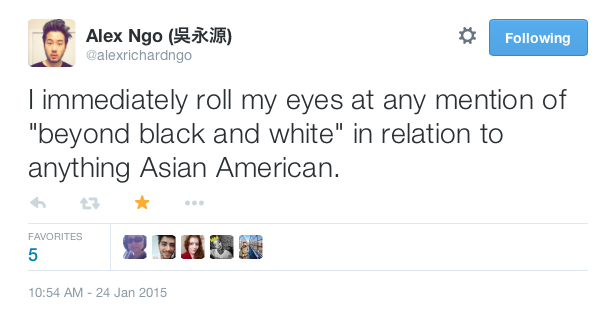
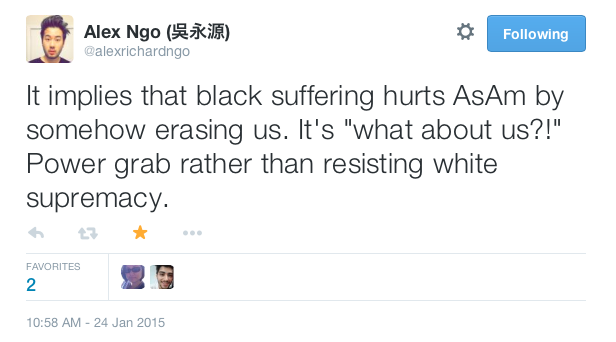
I came across a Tumblr blog that linked a couple of twitter posts by a guy name Alex Ngo (who is a journalist, I believe) that illustrates in one-hundred-and-forty words or less just how damaging intellectual laziness regarding the Asian-american narrative can be.

Here are the tweets....


The interesting thing about Twitter is that it forces users to distill their thoughts down to a few key words and concepts that often hints at a more sophisticated underlying social, or political zeitgeist. Such intellectually supported tweets can elicit immense response capable of galvanizing the public to action. Tweets deriving from a far weaker intellectual foundation, on the other hand, elicit little more than an eye-roll. Thus, if the underlying zeitgeist shows a paucity of intellectual depth, then this will be reflected in tweets on the subject. The above tweets are examples of the latter.

If it is incorrect to speak '"beyond the black/white' in relation to anything Asian-Americans", then the very concept of Asian and Asian-American has no reason to exist. By extension, any and all endeavours of such an entity have no purpose or meaning. Asian-American movies, literature, art, as well as contributions to science, politics, and philosophy are all rendered non-existent because much of this endeavour exists and takes place well outside of the artificial and hopelessly simplistic limitations imposed by the black/white framework.

This is particularly significant in light of the notion of diversity and the exclusion of Asian-Americans from considerations thereof. One of the arguments of diversity advocates is that it is necessary as a means to prepare today's generations for the increasingly globalized economy of the future where they will be required to compete in a diverse environment. How strange it is that in a world where the combined population of South, East and Southeast Asia approaches four billion (over half of the world's population) the diversity theory that claims to prepare Americans for what amounts to a world chock-full of Asians, would actually exclude this key demographic from the diversity dialogue.

Asian-American advocates who insist on maintaining the narrow black/white framework as a means to do who knows what for blacks and Asians, merely do a disservice to their own diversity goals. What exactly are such convoluted notions supposed to teach us about the place of Asians in the world if we insist on invisibility as a strategy and propose that exclusion from diversity considerations are acceptable? Are we to send our diversity-empowered future generations out into a global marketplace where the majority of people have Asiatic faces with the idea that their stories and experiences are insignificant or secondary? For those who claim to be fighting white-supremacy that is a remarkably western-centric point of view.

Clearly, if diversity advocates are genuinely hoping to prepare Americans for the global marketplace, we have to increase the visibility of, and mainstream, the Asian-American experience as an autonomous and unique experience in its own right in order to familiarize the American public with ways to successfully negotiate a world that is full of Asians. But, it is the second tweet above that illustrates the poor reasoning fostered by the simplistic assertion of the primacy of the black/white framework.

Simply put, there is no logical reason to presume that a call for less invisibility for the Asian-American narrative is in any way in conflict with anti-anti-blackness activism. This is merely an arbitrary dichotomy that is false and makes no logical sense. If Asian-Americans cannot fathom a way for an outspoken, autonomous, and visible, Asian-American experiential narrative to co-exist with social justice activism, then that merely speaks of the limitations in their thinking and does not reflect any real conflict of interests. It is worth noting that despite all of the impassioned claims that Asian-American anti-anti-blackness reactivists have made about the need to forego any consideration of an independent Asian-American voice, none have ever bothered to explain why such a dichotomy is mutually destructive. We are simply told to believe that an autonomous Asian-American narrative harms blackness, so shut up and fall in line. At least provide us the courtesy of explaining such assertions, otherwise shut up.

The fact is, that there is already an Asian-American experience that is independent of the black/white framework in spite of the best efforts of Asian-America's racial justice reactivists to ensure that such an experience remains marginalized. If there are some who wish to diminish, banish, or ignore this experience, then let them step aside and permit those who find value in the rich history of Asian-American endeavour to speak for the community.

I see absolutely no conflict or obstacle in seeking to explore the Asian-American experience as an autonomous endeavour and the fight for social justice. That is merely a bizarre notion entirely made up by social justice activists for some reason that I cannot even begin to understand or even consider worth the effort of trying to understand. It is that absurd.

Monday, January 19, 2015

Loose Lips Sink Ships.....

......Asian Privilege And Self-Sabotage.

Over the past three years or so, a new hope has emerged amongst Asian advocates of a way to wedge the community into the race dialogue without going to the trouble of first formulating a bothersome autonomous narrative of an Asian racial experience. Whisperings and rumors began to swirl of a powerful new entity whose emergence from the light would propel Asians out of the darkness of the facts of their own experiences to morph into a vestigial appendage, like a bubo under the armpit of, anti-blackness. Its name was.....Asian Privilege.

I first became aware of the idea of Asian Privilege back in 2012 from a post in Hyphen Magazine that asked the question; Is There Privilege in Being Asian American? Written by Bruce Reyes Chow, the piece says this......
As Asian Americans, if we are going to stand in solidarity with our African American brothers and sisters, we must not only acknowledge our forms of privilege, but leverage the influence that comes with that privilege in order to serve as allies to Black communities as well as other marginalized groups. There is privilege for many Asian Americans in not generally being perceived as threatening, which allows us to move about public spaces without eliciting suspicion.
My first thought is to wonder why it is so important to "acknowledge our privilege" but seemingly not so important to acknowledge that as beings with agency who make moral choices and utilize reason and rational thinking, that we might have a more sophisticated set of reasons to stand in solidarity with anyone suffering injustice. My sense of justice or altruism alone would surely be enough to warrant a moral decision in favor of standing with any oppressed group against injustice? Aside from that, my sense of compassion, empathy, sympathy, or simple good-will should impel me to side with the cause of justice and fairness.

Privilege - particularly the idea of owning it - simply is not a part of the equation. My second thought on the quote above is how bizarre it is that not being seen as threatening can be conceived of as a privilege. In the context of the Asian-American racial experience a more accurate statement would be to say that Asians are simply not seen, threatening or not - and that is a function of anti-Asian stereotyping. Most interesting, though, is this idea of leveraging this privilege to serve allies and other oppressed groups, particularly when that privilege consists of invisibility. How can a disadvantage - like invisibility - be leveraged to influence anything?

On the whole, the article actually does a fair job of highlighting some of the ways that racism impacts Asian-Americans but never really provides a clear illustration or definition of what Asian privilege is. Mention is made of immigration and academic privileges, but being allowed to immigrate in the same manner as other groups is far from being a privilege, and it is merely conjecture (bordering on inflammatory) to claim that Asians have access to academic settings merely because of assumptions.

This is the general problem that I have with the narrative of Asian privilege; no-one seems able to quite pin down what it means or even give reasonable examples of it in action. Even more importantly, since it is such a vague notion, and little more than a value judgment, the assertion of Asian privilege exists merely as one more sweeping generalization about Asian-Americans.

Since the Hyphen piece was published there have been several articles in the Asian-American media where the existence and notion of Asian privilege has been further referenced, asserted or discussed. Most of the ones I have read take the existence of Asian privilege as a given, although there is still much vagueness about how it manifests, or even why these manifestations should even be thought of as privilege. The basis for this assertion of Asian Privilege seems to lie in various stats that show high Asian college achievement and a healthy income level that, for some Asian groups, surpasses that of even the white community.

But none of these statistical analyses come even remotely close to showing that privileges are somehow imparted to Asians from the white establishment in order to help keep blacks in their place, or even that there is such a conveyance of privilege at all. There is simply no reason to believe that Asians are the recipients of any advantageous treatment at all. In fact, the possibility that Asians are even outperforming whites actually is a point against the notion of Asian privilege since it seems absurd to think that Asians would be given advantages by a racist white establishment that would result in what is fundamentally a disadvantage for whites. In other words, I am being asked to believe that a racist white establishment is driven to undermine blacks so much that they are willing to privilege Asians even over whites to achieve it? That is known as cutting off your nose to spite your face and the mere suggestion of it is worthy only of derision.

Even worse, though, is the possibility that by claiming privilege, Asians have hurt the black struggle for justice. The co-opting of the idea of Asian Privilege by Adam Carolla and Bill O'Reilly last year shows just why Asians shoot themselves in the foot every time they come up with one of these convoluted schemes that attempt to frame the Asian experience of race in the context of anti-blackness. No conservative even thought to think of Asians as having privilege until, that is, Asian-Americans themselves came up with the bright idea of interpreting the various data points of Asian "success" as some kind indication of imparted privilege. Of course, I cannot possibly know whether Carolla and O'Reilly were influenced by Asian-American musings on Asian privilege, but there is little doubt that Asian-Americans themselves bear the brunt of the responsibility for formulating and propagating an idea that has been picked up on and utilized by the very race-baiters they abhor.

The problem is that if Asian Privilege is real, then devoid of comprehensive evidence for it, O'Reilly's inferences are as valid as anyone's. If you can infer Asian privilege from a group of stats, then you can with equal validity infer black dysfunction from the same data set. Even worse, if we infer that the white establishment does indeed proffer privileged treatment to one minority, it is equally valid to infer that such an offer is a meritorious consideration - a clear point in favor of the notion that blacks aren't trying hard enough. In other words, the idea of Asian Privilege undermines the argument that blacks are held back by racism since there is no logical reason for one minority to be elevated over another to the degree that they apparently outperform whites. Again, we have to ask the question; does it make sense that a racist white establishment would privilege a visible racial minority to the extent that they would disadvantage whites?

If Asian Privilege is real, it undermines even the whole notion of a racist white establishment since, if it was somehow privileging Asians it would be unlikely to do so at the expense of whites if the motivation was to maintain white supremacy. If you believe in a racist white establishment then you cannot possibly believe that such an establishment would privilege a racial minority at the expense of its own race. Thus, to believe in Asian privilege undermines the case for racially motivated social injustices since no racist establishment would privilege another race over its own.

Clearly, the notion of Asian Privilege is a piss-poor heuristic that does little to advance understanding of Asian-Americans and even less to understand the propagation of injustices against African-Americans. As a poorly examined, but hysterically embraced, ontology, it obscures both the Asian-American experience, but also over complicates the conversation on race by needlessly making Asian guilt an issue in the race conversation. Worse still, by undermining the case for white racism it implicitly undermines the case for all racially derived injustices - even, funnily enough,  anti-blackness. Good one.

This and my previous two posts have highlighted what I perceive to be a reluctance and even fierce opposition amongst Asian-American commentators to embrace an autonomous Asian-American racial experience, even to the extent that any efforts to focus on Asians are discredited or even derided by Asian-American "advocates". As I hope to have shown, not only does this tendency further marginalize Asian-Americans, the vague and flimsily established notions of the model minority and Asian Privilege that Asians have embraced as the basis for their anti-anti-blackness sensibilities could actually have the potential to harm the cause of anti-racism far more than it could possibly help.

On a final note, I could not have planned it better myself but it says a lot about this supposed Asian privilege that the most widely disseminated discussion on Bill O'Reilly's screed took place between none other than two white men. Yeah, not an Asian in sight to offer an Asian perspective on a subject that supposedly defines our community.

Sunday, August 17, 2014

Damn...

..Arthur Chu Gets It Right.

In the past I have criticized Arthur Chu for some aspects of his writing, but his latest piece is written with the kind of oppositional spirit that is all too-often lacking in Asian-American writers who have access to mainstream exposure. To me, Chu's piece should typify the Asian-American approach to writing about our experiences and not be the exception

I won't reprint the piece here, but here are some excepts......
It was a moral that explained many things. It explained, for instance, why he never went to parent-teacher association events, never integrated himself into “the community.” Why he consistently obeyed Rule #1, a rule that my friends’ white suburban parents had never considered—a rule I would not hear from others until I actually met people who’d grown up urban and poor when I got older—Never Talk to the Cops. (In the Bill of Rights it’s actually Rule #5.)........Why he urged me to choose a career specialization based on objective assessment of skills and achievements, one where success was quantifiable, one whose practitioners were organizationally indispensable. To take an “Asian” job like engineer, scientist, programmer. One where there was little room for subjectivity, where the personal impression of the interviewer counted less. To stay away most of all from fields where I would be judged purely based on how well people could relate to me, like direct sales, like middle management, like the performing arts........To never, ever, ever put my livelihood in a position where I depended on white people liking me.
That lesson was: This Is Not Your Country.........You can live here. You can make friends. You can try to live by the law and be a decent citizen and even maybe make a lot of money.....But you will never, ever belong. You will never, ever be one of them. And you must never, ever trust them. 
I swallowed it all. As much as I could. I swallowed things that tasted foul and struggled to keep them down, but I did the best I could, to prove I could, to prove that I could swallow anything. I stomached the Chinese Exclusion Acts and the Riots of 1871. The gold miners and the borax miners and the railroad workers. I held my nose and I ate Jack London and the Yellow Peril and the coming war with China. I swallowed H.S. Tsien's deportation and Cold War paranoia and Joe McCarthy and the Yellow Peril and the coming war with China. I choked down Wen Ho Lee’s arrest and Vincent Chin’s murder and Iris Chang’s suicide and Andrew Breitbart and the Yellow Peril and the coming war with China. 
The historical atrocities and the daily microaggressions. Kids who screamed “Chinese Pig!” and adults who asked in an exasperated tone “I mean where are you from originally?” John McCain and the gooks he could never forgive.
The white racist looks at me and sees a stolen job or the slow decline of national prominence, but he doesn’t see a rapist, a thug, a barbarian at the gate. I fear being snubbed and sometimes spat on but rarely shot. And that is a very important difference.
Please go over there and read the whole piece, I don't think I have read many pieces like it that are so honest about the Asian experience.

The only caveat I have is that it would be easy to view the piece and the sentiment as a mere tag-on or afterthought in the story of African-Americans, and whilst I see some value in intersectionality, the fact remains that the Asian racial experiences that Chu describes are sufficiently serious and do not require the intersectionality with the black experience to be given more credibility.

Wednesday, June 11, 2014

Emasculation And Asian Male Sexuality.

Are We Afraid Of Free Choice For Asian Men?

In the wake of the recent tragic shooting in Isla Vista, in which Elliot Rodger murdered his two room-mates and their friend as well as three random people who happened to be in the wrong place at the wrong time, a spate of blog posts and news articles were published that sought to make sense of the tragedy. What I found interesting is the way that writers with different agendas focused on their own specific aspect of the tragedy; feminists focused on Rodger's misogyny, black folks focused on his anti-black racism, gun-control advocates focused on his guns, and gun-control opponents focused on his mental illness.

One interesting perspective came from Jenn over at the Reappropriate blog, who coined a new word - misogylinity - to describe what she views as an unhealthy adoption by a segment of Asian-American men of hyper-sexuality as a means to define their masculinity as a response to America's cultural emasculation of Asian men. In short, Jenn suggests that this creates an environment of "woman-hate" - the kind that Elliot Rodger latched onto to justify his misogyny - that leads this particular group of Asian men to disrespect and demean women. Whilst acknowledging the need for a positive response to the emasculation of Asian men, Jenn question whether we should be more nuanced about the kind masculine ideals we should (politically) push for. Her suggestion is to somehow "de-link" sexuality from masculinity such that sexual conquest does not come to define what it means to be a man.....
But let’s be clear: this sex-based masculinity is not actual masculinity. It is something else: let’s call it “misogylinity”..........................Too often, we narrowly (and sometimes uncritically) promote pop culture images of Asian American men in sexual or romantic roles (where the character’s explicit heterosexuality alone defines the character as empowering and masculine). Too often, we revere characters like JT Tran, who sells an Asian American-specific version of pick-up artistry workshops, and David Choe, who hosted a popular Asian American-focused podcast that intended to subvert Asian American emasculation through real or manufactured tales of sexual conquest (where he also allegedly confessed to rape).
Firstly, it is worth pointing out that the first half of that paragraph above is somewhat at odds with my own experience. I don't ever remember any Asian-American - male or female, and certainly no-one of any significant influence whatsoever - actually promoting any Asian male media character based solely on their heterosexuality alone. On the contrary, almost all commentators on the subject seek to promote Asian male (and female) characters in the media who are well rounded and human. People seem to want to promote Asian male characters who are physically strong, emotionally complex, and yes, not devoid of sexuality. But it is certainly a stretch to claim that Asian masculinity is being promoted by way of sexuality alone.

At the same time, does it really need saying why there is (and should be) a focus on Asian male heterosexuality? How about this; it is specifically Asian male heterosexuality that is being maligned and demeaned by American culture? I am not aware of any habit or practice within mainstream culture of demeaning gay Asian men based on their homosexuality. So, suggesting that there might be other ways of addressing sexual dehumanization of Asian men is somewhat absurd - akin to holding you hands over your groin protectively to defend against punches to your face. What other Asian male sexuality is or has been under attack? That aside, the main thrust of the piece is that Asian men who adopt a hyper-sexualized identity as the basis for their masculinity are, basically, to be marginalized by the community at large.

In the latter half of the paragraph, two men in particular are offered up as examples of the kind of Asian man and Asian man behaviour we should eschew. Pick-up artist, JT Tran, and Korean-American artist, and sex fantasist, David Choe, are presented as the kind of slimy characters we would all do well to avoid. The argument is that we should not be giving time to, or supporting, those Asian men - like Tran and Choe - who promote the idea of sex and sexual conquest as some kind of remedy to the emasculation of Asian men. The reason is that they are - it is asserted - misogynists (both) or possible-rapists (Choe) whose hyper-sexualized personas are implicitly "oppressing" other identities....
Do we sometimes let the fight to reclaim Asian American masculinity rationalize the recreation of systems of oppression against other Asian American identities?
I am not going to defend Asian PUA or Choe (still not sure what his sin was), but what I do find disturbing is the puritanical and un-nuanced judgment that hyper-sexualized Asian men or simply the pursuit of a hyper-sexualized lifestyle as an expression of masculinity is somehow morally reprehensible and something we should marginalize out of the community. The piece never gets around to explaining why a masculinity that is heavily informed by hyper-sexuality is implicitly bad. The closest it comes to an explanation is to suggest that hyper-sexual Asian men are somehow implicitly misogynistic, but a broad-brush assertion is a weak argument for a proposal that seems to seek to interfere in individuals' lives on the grounds of our own presumed ethical superiority.

The first problem here is that we live in 21st Century America, and there exists a rather vibrant culture of casual sex and casual pick-up in which both men and women are happy and eager to participate and both sexes use eachother. Bars and clubs (not to mention the college campus bars and notorious spring breaks) all over the US are packed every weekend with single people whose goal is to hook-up - and it is entirely consensual. This means that there is an environment where people like Tran who choose (or merely possess) a highly sexualized identity are welcomed - so in order to imply a moral transgression by Tran, one would have to make sweeping moral judgements on the lifestyle itself. Good luck with that, and if you succeed, then welcome to Taliban USA. Sadly, it is difficult (and unethical) to to impose our own set of ethical values on the actions of willing consensual adults, but even worse, this idea that hyper-sexualized Asian men are a threat seems to merely echo white -supremacists ideas of the sexually rapacious Asian man who presents a threat to white womanhood.

The point here is that that lifestyle is a choice - and insinuating some kind of moral judgement on people who make different choices to ourselves is simply a repression of diverse individualities and nothing more. But worst of all, the idea that an identity that is based largely on sexuality is implicitly something to eschew is never argued effectively for in the post. The only way to answer this is with a question; why? Why is pursuing many sexual partners something we should pour moral scorn upon, and why is it wrong to have an identity that is based on high sexualization? The answer is that it is not - you just can't get passed that consenting adult issue.

Jenn's post calls on the community to redefine what we mean by, and how we present, Asian masculinity whilst inserting the caveat that sexuality based masculinity is to be avoided which, ironically, is an example of oppression of other Asian identities. Who made the judgement that says that masculine identity based on sexuality is wrong, inappropriate or, even, not empowering? Should we make highly sexualized Asian men into some kind of pariah caste because they have made a choice that - for whatever reason - has made some of us uncomfortable? Or, is it better to mind our own business and not try to control and judge other people's choices? How on earth can anyone claim to know that what individuals claim gives them a sense of empowerment is not actually giving them a sense of empowerment?

It is especially confounding that we are even talking about this since - as I pointed out in this comment - Asian feminists have for years presented an aggressive and independent sexuality as a means of empowerment - they (rightfully) choose their own sexuality and they can attach whatever importance to it that they choose; if Asian feminists choose to frame their sexuality as socially and culturally empowering, then so be it, and who are we to argue? Likewise, if there exist Asian men who feel their sexual conquests assuages America's dehumanization of them, who are we to tell them it does not? Jenn seems comfortable leaving room for the possibility that Asian female sexuality and the expression thereof can be politicized and empowering, yet erects (no pun) a moral barrier at the thought of Asian men finding empowerment through the exploration of their sexuality.

Here is where the problem with painting with a broad brush comes back to haunt you. Sexuality, for many people, is hugely integral to their character. People who have been in long-term relationships may still view their identity as highly sexualized and even base their sense of masculinity (or femininity) on their sexual endeavours with their partner. In fact, that sense of "conquest" of your partner does not necessarily go away for people in long-term relationships, and I would guess contributes greatly to the sense of femininity for women and masculinity for men. Are these people to be stigmatized too? Is getting many fucks out of a single partner equally as morally reprehensible as getting single fucks out of many partners? I need more convincing.

Of course, the argument that PUA offers a snake-oil remedy for Asian men who struggle to get dates that ultimately backfires is a legitimate one, and Jenn's piece makes much of the fact that Elliot Rodger felt even more desperate after apparently failing with PUA techniques - although it is not entirely clear that Rodger actually took any PUA classes. Regardless, the focus on that point (although valid - false advertising is false advertising, after all), for the purpose of supporting a vague moral argument to marginalize Asian men with high sex-drives also, sadly, deflects attention away from the fact that the field of psychotherapy also failed to reach Rodger. Yet, no-one has suggested that the failure of psychotherapy to create a meaningful psychological shift in Elliot Rodger reflects any failure on the part of the profession itself.

In the context of Asian and Asian-American mental health, the psychotherapeutic process is complicated by racial and cultural factors which have been documented to impede therapeutic success. Now, as a community, we sound off about Asian-American mental health, yet, in one of the clearest examples of an Asian-American whose mental state made him unreachable, we somehow conspire to miss the opportunity to highlight the unique challenges facing Asian-Americans with mental health issues. From what I understand, Rodger had been in therapy since childhood, and even though I cannot possibly know the specifics of his therapeutic plan, it is worth considering the possibility that the unique experience of cultural marginalization, normalized cultural dehumanization and emasculating stereotypes that promote demeaning behaviours and attitudes, might perhaps have been outside of the realm of experience for his therapists to address, even if they were Asian themselves.

All of this highlights some disturbing facts about emasculation and how we conceive of its character and effects on Asian men. Because Rodger focused his ravings on sexual conquest it is natural to consider his feelings of sexual disempowerment as the fundamental cause of his sense of emasculation. But this is merely narrow thinking. Rodger was - throughout his entire life, possibly before sexuality even became a factor for him - emasculated, even in childhood. This came about through bullying and marginalization. The emasculation of Elliot Rodger quite possibly had as much to do with an inability to assert himself in his social environment, or his inability to find an empowered voice that could enable him to assert control over his own experiences, as much as any inability to get laid. Are we really choosing to believe that Rodger killed mostly because he could not get laid, based on his arguably mad rantings?

If we do choose to follow this narrow understanding then we miss the opportunity to realize that emasculation is a form of dehumanization that attacks and demeans every aspect of a man. This includes their sexuality, but also other equally important aspects of their identity such as their sense of confidence, ability to provide for their family, or their opportunities for participation in the cultural life of their society. For example, men have rampaged when they have lost their job because being economically fruitful is implicit in a masculine identity. Emasculation is not just about sex if it was, then  how can we explain that fact that black men are hyper-sexualized, but there are still voices in that community who argue that this society emasculates black men by capping job opportunities, or stigmatizing their educational abilities.

The point here is that emasculation of minority men occurs in a number of ways, and as I pointed out above, there any number of qualities that we positively associate with masculinity that when compromised can lead to violent or misogynistic behaviour, so focusing on ideas of Asian male hyper-sexuality as being a dangerous echo of Elliot Rodger's type misogyny simply does not add up, and to think of it that way might serve an agenda, but does little to improve our understanding of the nuanced nature of racially inflected emasculation.

We should not lose sight of the fact that emasculation is about control, or more specifically about the power to control a man's life, social identity, and opportunities, being in the hands of people other than the man himself. It is emasculating for black men that their opportunities in employment and education are often unfairly limited by factors outside of their control. It is emasculating for Asian men that some nameless and faceless media types are able to define what it means to be an Asian man in an apparently arbitrary and defamatory way, that they have no control over.

This is a point that requires more consideration - the root of Asian male emasculation is the appropriation of our capacity to define ourselves within the context of our culture and society - everything else is secondary to that. For example, I view jokes about Asian men's dicks as emasculating because they represent the capacity and power of others to arbitrarily define and describe our bodies - the joke itself is meaningless. It, and every other derogatory stereotypes are merely symptoms of the problem, and not the problem itself. Just like rape is considered less about sex and more about asserting power, emasculation is fundamentally the capacity to assert arbitrary power over other men.

This is why personal choice is all important in the struggle against emasculation. It is, therefore, ironic that a blog post that seeks to promote "healthier" conceptions of male masculinity, seeks to do so by controlling and limiting some self-definitions and choices simply because we don't like it. Even worse, is the irrational fear that such hyper-sexual masculinity when skewed could lead to more Elliot Rodgers, when the fact is that any masculine quality (any human quality, in fact) can lead to tragic events when we abuse them.

Tuesday, May 13, 2014

Donald Sterling And Racism In America....

.....And Why Asians Have Nothing To Answer For.

There is an article in Slate that has been making the rounds written by a couple of Asian-Americans on the recent furore over Clippers' owner Donald Sterling's racist remarks about African-Americans. The piece parses the bigger picture of Sterling's racist attitudes and does a good job of contextualizing his supposed "love" of Koreans as merely another way of expressing a racialized and racist way of thinking.

As one might expect, the article goes to great pains to highlight the idea of the Model Minority myth as a cause of this way of thinking, noting that racism is not always - in fact is never - only about hatred, but can be expressed even as one expresses love and admiration.
While it’s not quite on par with degrading other minorities as lazy or filthy, Sterling’s praise for his hardworking Korean tenants and the “Asian way” reveals how racism can be a collection of contradictory impulses. Love and hate, praise and condescension—they are all engines of exploitation.
Oddly enough, this notion of racism being expressed through love is not new, and was most eloquently described by none other than Frank Chin - the largely marginalized and under-appreciated Chinese-American writer - whose brutal directness and unwillingness to compromise on historical and cultural truths has made him an anathema to the far more prominent historical revisionists within Asian-America. Personally, I like the guy. Way back in 1972, Chin wrote a piece called "Racist Love" that encapsulates with great eloquence and directness this idea that racism does not necessarily thrive on hatred alone, but is just as equally upheld by "love". Read it and weep.

Of course, the Slate piece should be read as a refutation of the idea that the "model minority" is a positive thing, and in that regard I wholeheartedly agree. What I find problematic about the piece - and about Asian-American commentary on the model minority stereotype as a whole - is that we always fail to point out the most uncomfortable truth about it. When Asian-Americans talk about the model minority the usual trope is that the stereotype upholds the idea that racism can be overcome through hard work as proven by Asian "success", whilst simultaneously faulting other minorities - black and Hispanic - for not doing the same. The story goes that since Asians - supposedly - don't complain about racism and just put their heads down and "get on with it" that this is a good model of behaviour for all minorities to follow - hence Asians are the "model minority". In other words, the stereotype implicitly and explicitly justifies racist attitudes towards blacks and Hispanics by blaming them and not racism for their inability to succeed.

The typical Asian response - naturally, perhaps - is to decry the stereotype for its racist love and for its detrimental effects on other minorities, criticize Asians who "embrace" the stereotype, and most significantly of all, to criticize Asians who might embrace the stereotype or simply fail to speak out against it. The reasoning goes that Asians who embrace or are silent about the stereotype are implicitly upholding white racism and in return are given "privileged" status or simply given just "privilege". I have written about this notion of Asian model minority privilege elsewhere, but the story goes that by participating in white supremacy - that is, by accepting privileges (often unspecified by critics) that enable Asians to "prosper" - and not challenging the structures that uphold it (presumably by quitting college or jobs, perhaps?), Asians are being complicit in anti-black/anti-Hispanic white supremacist racism. As the article notes....
The housing case brought against Sterling in 2003 includes black, Latino, and white plaintiffs but no Korean-Americans. We have not been able to find prominent public complaints against Sterling by any Asian-American individuals or groups. There are also troubling stories of Sterling at one point replacing his security team with “Korean-born guards who were hostile to non-Koreans.”
Although there is no explicit criticism of Asian-Americans in the piece for not speaking out against Sterling's long list of racially demeaning statements and activities, pointing out that Asians have not made any substantial complaints about him is, to me, an implicit observation on supposed Asian "passivity" when it comes to speaking out about racism directed at both Asians and non-Asians alike. As other prominent bloggers have suggested, because Asian privilege is - supposedly - unique in that we are afforded opportunities to prosper not given to other minorities, then we are uniquely required to be more vocal about racism.

This way of thinking leaves us with a substantial elephant in the room. As I pointed out in  my other model minority post, if it is true that to succeed requires complicity with white supremacy, then it must also be true that for any minority to succeed, they have to also be complicit with white supremacy and, in fact, many non-Asian minorities do succeed. In fact the Sterling case is an awkward illustration of this notion in action. Although Sterling has a long history of expressing racist opinions and enacting racist policies in his work, and although lawsuits have been brought against him by aggrieved parties, the fact is that for at least the two plus decades that Sterling has been expressing racially charged opinions and discriminating against blacks and Hispanics, there has been - as far as I know - almost no complaints or activism from black or Hispanic employees within his Clippers organization about his prejudices.

That is, aside from the most recent on-court, pre-game, "protest" by Clippers players against Sterling's most recent transgression, the black players, coaches, and whatever black support staff he employs, have been largely silent in challenging Sterling's prejudices which have been out in the open for years. In other words, they have been guilty of "model minority" behaviour - accepting the status quo in exchange for "privileges" and the opportunity to prosper. I am not criticizing the apparent passivity of black employees of the Clippers organization here, but merely pointing out that speaking out against structural racism is far more complex and difficult to do than merely following a set of college-learned ideals and imposing that set of ideals on real people in the real world (with families to support and children to feed) and finding imperfection in those people because they have to make real-world choices.

Clearly, Asians are not alone when it comes to keeping quiet and keeping their heads down instead of confronting racism head-on, the only difference is that  whereas blacks and Hispanics have a strong cultural and social voice, Asians have a weak cultural, social, and political, presence and it is, thus, easy to label us and make it stick. As I have shown, no-one is faulting black Clippers employees for their years of apparent silence over Sterling's racism.

But even the idea that Asians don't speak out about racism is clearly false. Blogs like my own, and even other Asian bloggers whose focus is not the racial experience include commentary and speak out about racism. Often, in the aftermath of yet another racist media slight, Asian journalists or writers will post articles in mainstream publications speaking out about racism. So why we have this idea that Asian don't speak out about racism I don't know because clearly, we do. But this perception itself illustrates just how excluded Asians are from the processes by which perceptions of us are formed. Despite the fact that Asians regularly speak out about racism, the wider perception is that we don't, which is probably because the images and statements that are  given the most gravity are made or created by non-Asians, often relying on formulaic and derogatory conceptions of Asian people, and who have the full power of the media apparatus at their disposal. All of this means that to buy  into the idea that Asians don't speak out about racism is to in some ways hold Asians responsible for their own exclusion and invisibility in mainstream culture. Even worse, to suggest that Asians are uniquely and specifically more disinclined to challenge racism's structures is merely more stereotyping.

Asians have very little to no control over America's race dialogue on Asians - this is a simple fact. That is why it is important that we refrain from an intra-community dialogue that over-simplifies our race experience and our responses to it. As the Sterling case has shown, any and all minorities once integrated economically into the system will overlook racial indignities and transgressions committed by the white power structures - Asians are not alone in that.
But the ultimate beneficiaries of this racial typecasting are the people who invoke the model as a bludgeon against others. Sterling’s admiration for his Korean tenants is actually a kind of scorn. After all, he still subjected Korean tenants to the same degrading treatment as everyone else—the only difference is that the Koreans seemed willing to take it.
That final sentence seems to be trying too hard and does not specify how Sterling's behaviour was degrading to Koreans, but it illustrates my points clearly. Nothing I have read anywhere says that Sterling degraded the Koreans, just like black players and staff at the Clipper's organization were not personally degraded (as far as I know) by him. Perhaps if there had been incidences of personal degradation the Koreans might have reacted, just like the black employees at the Clipper's organization might have reacted if they had experienced personal degradation - they certainly did not seem motivated to to speak out or protest on behalf of the victims of housing discriminatioın in Sterling's rental properties. The point is, that all minorities act the same when they become economically integrated, suggesting that expecting such economically integrated people to approach anti-racist activism like Malcolm X might not yield the desired results, or even be the desired approach.

The real damage here, though, is to suggest that there is something uniquely Asian about not speaking up against discrimination when they are not directly, or personally, affected by it. Clearly, all minorities who have achieved some degree of economic integration for one reason of another will not challenge discrimination unless they are personally affected by it - the Clipper's employees illustrate this. By implying that this is a uniquely Asian phenomenon is simply incorrect and only serves to deflect the dialogue away from any meaningful attempt to find a course of action that empowers minorities - not just the Asian ones - to embrace their economic success or integration, whilst challenging discrimination from within.

Pointing the finger at Asians only allows the very significant fact to go unnoticed that almost no minority groups who stand to lose what little piece of economic advantage they have attained will rarely jeopardize it to stand up for ati-racist ideals. This notion is too simplistic on top of being wrong - much like the kind of stereotyping we are targeted with - and in order to improve the Asian-American cultural, social and political footprint we need to offer dialogue about ourselves that is primarily accurate, and nuanced.

Wednesday, April 30, 2014

Asian-American Reactivism

Engineering Our Own Demise.

Anyone who has been around kids would probably agree that you can tell a child anything, but unless you actually model the behaviour that you insist upon in the child, then they will just begin to think that you are just a hypocritical adult bullshitter. "Do what I say, not what I do" does not get you very far. But this principle holds true in all human interactions - if  you go through life not practicing what you preach then, soon, you will lose credibility. You have to practice what you preach as individuals but it is also especially pertinently significant for a racialized group, like Asian-Americans.

A couple of events that have taken place in recent weeks have left me wondering if Asian-America can be criticized for not walking its talk, and failing to provide an appropriate model of behaviour of a kind that we insist mainstream America follow. We want our dignity to be respected, we want to be seen as individuals and we want (at least I know I want) reason and nuance to guide attitudes towards us. Yet, I think that all too often in our intra-Asian dialogue we seem reluctant, unable, or simply fail, to model this very thing.

I came across an extremely well-written and witty article, written by Arthur Chu - of Jeopardy fame - in which he very cleverly gave his thoughts on the "#CancelColbert" movement and its initiator, Suey Park. Viewing Park as a necessary and welcome evil, he writes the following....
I’m glad that we’re increasingly living in a world where nice people can be nice people and jerks can be jerks and game show villains can be game show villains without the need to be a “credit to your race.” That, slowly, haltingly, through a lot of debating and arguing and fighting and hashing tough shit out, we’re finding the freedom to just be ourselves.
Sounds good, except that earlier in the piece Chu wrote the following...
Suey Park is crazy. She does not represent us. She does not speak for us. She doesn’t speak for anyone except her fellow denizens of Angrytweets, USA, a community whose sole import is random entertainment news and whose sole export is intoxicating outrage.........I’m glad she’s out there. Because Asians need more villains.
What I find difficult to reconcile here is this idea that somehow being angry makes Park into a villain. Even worse, Park is crazy because she is angry. What seems to be happening here is that Chu is celebrating some kind of eccentricity that is not usually associated with Asians - which is true - but instead of letting Park's actions and behaviours speak for themselves - as he seems to want - , he actually seems to want to shape perceptions of her, so that it does not reflect back on him. He accomplishes this by stereotyping her as villainous and crazy.

Although I am critical of white celebs contextualizing America's race dialogue by getting it completely wrong, I have not agreed with the manner of Park's activism but she is not crazy for being wrong, and she certainly is not a villain for taking the wrong approach. The problem here is that Park is a living breathing human being who - by my reckoning - made and makes mistakes and I am simply uncomfortable with her being labeled because of it. Doing so does not sound like being genuinely open to a diverse, warts an' all conception of Asians because part of that process of acceptance of our warts is to leave open the possibility and hope that as individuals who make individual choices, some wrong, some not, we have the capacity to change. After all, isn't racism predicated on the idea of immutable, often negative, racial characteristics?

But there is a more profound issue here that I find troubling - even in cases where minority anger is justified, America still manages to stereotype it and mock it. We have stereotypes about the Angry Asian  Man (and now, perhaps woman), and we have stereotypes about black anger, and we laugh at them, and in the process diminish any legitimate concerns that  sparked the anger. Yet, white anger is taken seriously and given weight, and in no way is implied to reflect on any one other than the person expressing it, and rarely, if ever is white anger mocked via stereotype.

Of course, the cherry topping is the caveat that Park "does not represent us" and "she does not speak for us". Shouldn't it go without saying that it is reasonable to presume that Park's opinions represent little more than her own thinking? Why would Chu have to even say such a thing...unless...unless...there is some kind of process by which Asians are held to accountability as a group for the actions or behaviour of one of them? Maybe Park isn't so crazy after all.

But this tendency to pile in and beat each other down - even when we think we are doing the opposite - took an even more sinister and disturbing turn more recently when Korean-American artist, David Choe, told a story on his internet broadcast show that left many listeners believing that he had committed rape. Basically, the story goes like this; Choe claimed that in a "high-class spa" - that is a legitimate non-sex oriented spa - he pushed his female massage therapist's head onto his penis to make her perform fellatio, after which she proclaimed her previously unspoken sexual attraction for Choe, and requests his telephone number so that she can, you know, make it happen again - nudge, nudge, wink, wink. Of course, Choe is not interested, and gives her a false number.....uh-huh. That sounds believable.

My first reaction when I heard Choe telling the story was that he sounded like a fifteen-year-old boy, boasting to his friends about sexual encounters that never happened except in his own fantasies, or as an embellishment of a story he read in his dad's Playboy mags. Nothing about the story rings true, nothing about it made me think that I should take it seriously as a reflection of an actual incident, and even the manner of the telling came across like Choe was improvising the whole thing - badly - such that all I could think was "it did not happen".

But in the aftermath of the broadcast a furore erupted with accusations being made that Choe had actually committed rape and was effectively admitting to doing so. In the wake of this wave of repugnance for Choe, a petition was created - here - requesting that the White House remove Choe's paintings from its walls because.....
On 10 March 2014, David Choe aired an episode of a podcast called "DVDASA" describing a sexual exploit at a high-end massage parlor. Choe commented how the massage therapist, "Rose", did not want to be physically touched, responded "no" to his requests, and ultimately resulted in him physically pushing down her head onto his erect penis............While Choe has since recanted his remarks, stating he had made up the story, his commentary still has a significant impact due to his fame and perpetuates the myth that there is a rape spectrum, that no doesn't mean no, and rape is not always rape, but merely "rapey".......Choe may not be a rapist, but his painting of our President Obama does not deserve to represent his community at the White House.
Choe may not be a rapist, but his painting of our President Obama does not deserve to represent his community at the White House.
A previous version - the above has been updated, I believe - called on the White House to issue a statement on its stance regarding "alleged rape" (incidentally, what are the ethical considerations when one asks people to sign a petition and then one changes the wording of the petition after it has been signed?). Whilst I can certainly understand the negative reactions to Choe's comments and decry his gross insensitivity on a subject that is painful and very real for women, the fact is that he has not actually been proven to have committed or even charged with a crime.

In a court of law, the concept of reasonable doubt serves as a guiding principle for how we judge the accused - we apply reason, logic, and rational arguments to evidence and subsequently judge impartially. Furthermore, reasonable doubt also safeguards against abuses of judicial power by ensuring that evidence itself is not arbitrary (I feel, without evidence, that someone is guilty, is not reasonable evidence, for example), or that charges do not serve a political agenda. So, reasonable doubt is a hugely important aspect of guaranteeing our rights and protecting them from abuse.

With that in mind, it is disturbing that anyone would participate in a petition try to leap-frog the judicial process by calling on the Executive Branch of our government to basically treat Choe as though he were already convicted of a crime, and do damage to his reputation and possibly his livelihood by removing his work from the White House. In other words, the Executive is being asked to mete out punishment to Choe, effectively in lieu of his right to due process, and all based on a dubious story (subsequently retracted), and (somewhat) popular outrage.

Asian-Americans, of all people, should be painfully aware of the dangers of populist outrage, and popular sentiment in relation to the denial of due process, and I would not be surprised if many of the Asians who signed the petition would - with a completely straight face - decry Japanese internment and their denial of due process during World War 2. They too were punished without ever being convicted of any crimes, and it was done via an Executive order and with popular consent. We cannot have it both ways.

Sure, people are free to choose to boycott Choe, but to demand that the White House play a part in punishing or censuring someone who has not even been convicted of, or even legally charged with, any crime, does a greater disservice to Asian-Americans than Choe's stupidity. The petition states that Choe "does not deserve (emphasis mine) to represent his community", which carries with it an implicit call for the White House to make what amounts to a moral judgement - to be accompanied by a "punishment" - on a civil society matter, thus expanding the scope of the Executive role to include moral proclamation. It is a staggering irony that people who casually demand that an individual's right to due process be infringed upon by an Executive that also issues moral judgements, could somehow believe themselves to be the arbiters of what, or who, could be a deserving representative of our community.

No, these folks are far, far, far, worse, and Asian-America should distance itself from any hint of vindictive action that unapologetically seeks to punish someone who has not even been charged with a crime, and who seek to muddy democratic principles because someone said something upsetting. And this is what is so disappointing; by participating as Asian bloggers, writers, or signatories of a petition, in any activity that supports steamrollering someone's democratic rights, then we have effectively set the standard for how we ourselves can and should be treated in the eyes of the law and society in general. That is not to say that those angered by Choe's douchebag story should merely let it go (on the contrary feel free to take action within the realm of normal civil society activity if you wish), but it does mean that we should shoulder a responsibility to insist that nuance and reason guide behaviours towards any Asian, not emotion and vindictiveness.

This is because nuance and reason are the qualities most often absent from the behaviours and actions of mainstream America towards its Asian minority. We saw this during Japanese internment, and more recently in the Wen Ho Lee case. If Asian-Americans are not prepared to approach issues relating to Asian people with nuance and reason (and modes of interaction that uphold human dignity), then how can we demand it of others? In other words, if we want to be treated with respect and have our human dignity respected (even in cases where there is potential for crime, more so in cases where a crime has only been inferred to have been committed), then in a society that makes a point of not respecting our human dignity, we must surely be obliged to provide that model of behaviour that we insist mainstream America abide by?

Monday, March 17, 2014

An Asian-American Civil War

SCA 5 And Strategic Thinking

The world of Asian-America recently erupted into an epic ideological conflict over Californian aspirations to allow state schools to reintroduce racial criteria (known as SAC5) in their admissions processes. The plans have caused a sharp divide within Asian-America - those who oppose the legislation cite fears that Asian enrollment would be unfairly curtailed as colleges strive for quotas that reflect the balance of the general population, those who support the legislation cite social justice and diversity considerations.

In this post I will not argue for or against the legislation, suffice it to say that whilst I agree that promoting social justice and increasing genuine diversity are the way forward for a racially complex America, I find the idea of affirmative action as advocated by SAC 5 as a means to remedy these issues to be hopelessly insufficient. What interests me about this subject are my observations on the Asian-American commentaries and advocacy for the legislation.

What I find remarkable is that the Asian-American voice on this issue is simultaneously loud but also strangely drowned out and lost in the bigger picture of the debate. It is hard to deny that Asians on both sides of the debate are being extremely vocal about their beliefs, but what seems to be lacking is an imaginative and creative approach to solving the underlying issues that are retarding social justice that contribute to the lack of diversity not just in college admissions, but also in many areas of the socio-economic sphere.

Whilst Asian advocates have been at the forefront of cheerleading for the legislation, I have notice a glaring lack of Asian advocates exploring alternative, ideas for social justice beyond merely relaying the standard tropes of liberal ideology. I am yet to see Asian advocates for social justice who do support the notion of affirmative action in college admissions question whether it actually will have the effect of alleviating the injustices of long-term racialized poverty amongst ethnic minorities. I have doubts, and I am surprised that even those who are passionate about affirmative action seem disinclined to explore the subject beyond what is presented by "higher ups" in the liberal/conservative ideological arena. This is sad because it means that Asians are not actually taking leadership in shaping an Asian-American contribution to the quagmire of racial justice. We are not creating ideological road maps that challenge prevailing wisdoms about how to go about advancing our and other's aspirations for diversity and equality. In short, we are placing ourselves in positions of being mere messengers of other people's and group's ideas.

Much is said about the need for Asian-Americans to step out of the conscientiousness numbing coddling of the model minority stereotype and make a difference in the advancement of racial justice, but in the absence of an innovative road map, where does the inspiration come from that will motivate us to do just that? The conservative/liberal umbrellas under which ideological battles are fought seems to have major holes over the areas where Asians are standing, and many Asians feel that they are invisible in this dichotomy, and I tend to agree. But the answer to invisibility is not to merely shout louder and become the most aggressive cheerleader, but rather to become those who shape the ideological landscape.

One way to think about it is to consider how almost to a person, Asian-Americans will agree that the lack of culturally appropriate Asian images and positive role-models creates problems of identity and sense of exclusion. Likewise, my sense is that in the realm of political action we lack meaningful role models whose approach is original and creative and who inspires ideological identification amongst Asian-Americans. What I mean by this is that - echoing the identity conflicts of Asian-America - there has been a failure of advocates to model an Asian-American political identity that reflects our unique experiences as a minority whose cultures or civilization are viewed as implicitly incompatible, or in existential conflict, with the west. It is almost as though Asian advocates want to parachute Asian faces into the middle of America's political and social landscape without first establishing the unique and specific experiences of Asian-Americans as an autonomous and worthy aspect of that landscape.

What seems to have been the preferred strategy is to act as "persuaders" for the big issues of the day as opposed to the shapers of those issues. Some might suggest that relatively low numbers of Asians makes such an approach practical, but creating original avenues for advocacy does not require large numbers of people - it only requires people willing to question political orthodoxies and look for alternative ways to solve them.

The topical issue of affirmative action in college admissions offers us a clear example of this. At the root of the conflict between the two warring sides is the issue of how the reintroduction of race as part of the admission criteria will affect Asian enrollment. Given the fact of Asian invisibility and general social resentment or indifference towards Asian achievement in American society, the fears that Asians will be unfairly negatively affected by SAC5 in favour of more "likeable" and politically influential minority groups whose achievements are more likely to bolster liberal political careers, are legitimate ones.

Some responses to these concerns have been disappointing to say the least. In what amounts to a smearing tactic, opponents of SAC5 are being labelled as "haters" purveying "lies" by Asian advocates as this piece in the very widely read AngryAsianMan blog (although not written by him) shows. This is sad in a number of ways. Firstly, it is a very childish approach to a very serious problem - "haters"? Really? The only thing missing from the piece is to gloat about "PWNING" the "haters". Secondly, this piece shows a lack of sophistication in Asian-American discourse, and that Asian advocacy also produces second-rate polemics to accompany its lack of creativity.

In conclusion, as I suggested here, people are motivated by inspiration, but, sadly, it seems as though this ability to inspire is what is lacking amongst Asian advocates for social justice. Asian-Americans are often criticized for their supposed political apathy, but the debate over SAC5 has really opened my eyes, and the problem is not that Asians are implicitly placid in politics - that is merely a racist stereotype. Just observe the months of political involvement and protesting in Thailand, labor unrest in Cambodia, rebellions in Burma, and the almost constant protesting in China, as well as the ubiquitous anti-corruption protesting in the Philippines. Asians are not politically apathetic and are quite willing to fight for what they believe in even to the point of dying for their beliefs.

This can only mean that supposed Asian-American political apathy is not the consequence of specific innate racial and cultural qualities of Asian people, but is more likely the result of poor and uninspiring leadership from Asian-American advocates, who sometimes seem to advocate for Asians by ignoring their concerns. Given that proponents of SAC5 are vague in what it entails - at one and the same time it will ensure that college populations are more representative of the demographics of the state, but somehow won't require quotas, the amendment will use race as one of the admissions factors, without telling us what someone's race tells us about their qualities, and most of all, it doesn't tell us how the legislation will improve inter-generational poverty (which is the point of affirmative action) - it is no surprise that Asian-Americans are looking uninspired by the whole idea.